
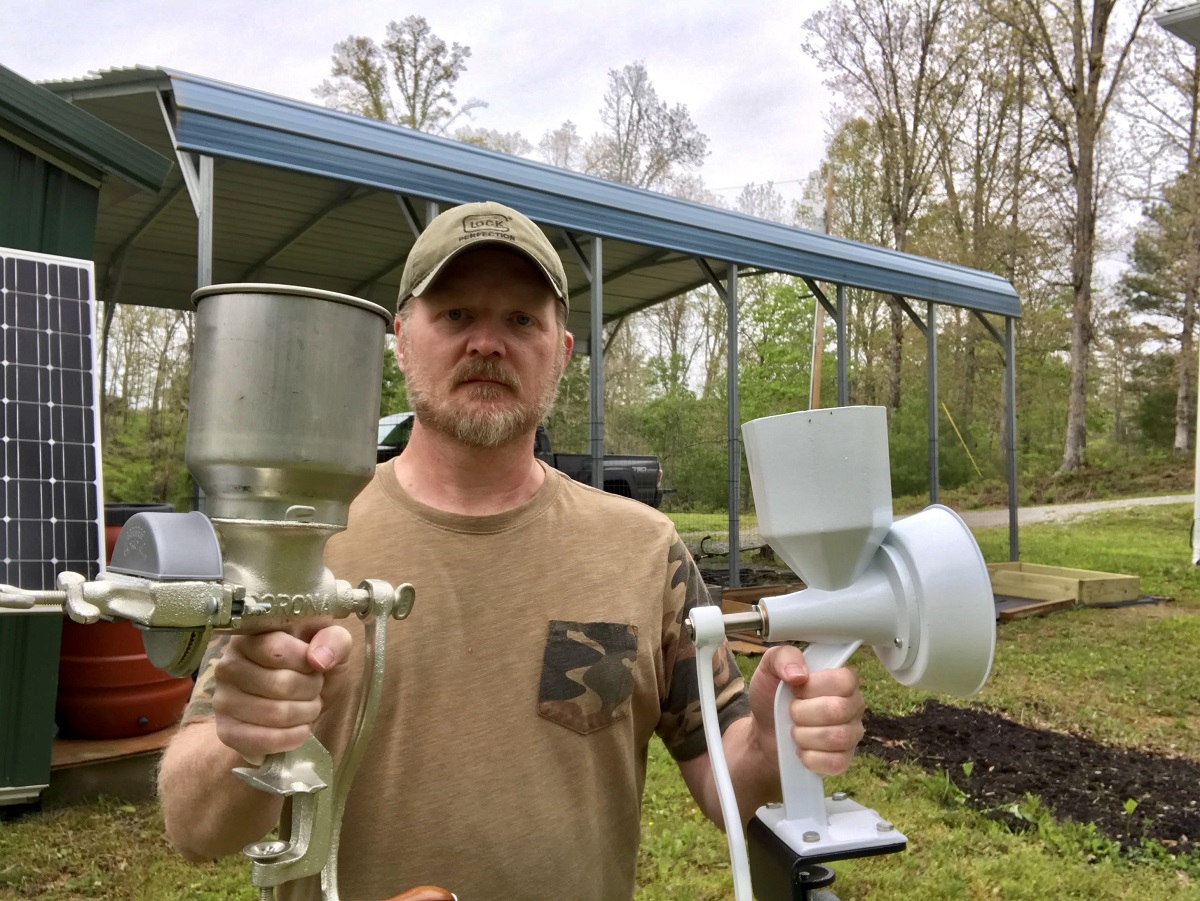
Most homes already contain the basic pots, pans, mixing bowls, knives, and utensils needed to cook food from a survival pantry.
What most kitchens do not have is the equipment needed to turn buckets of whole wheat, corn, beans, and other grains into flour, meal, or cracked grain.
If your long-term food-storage plan includes whole grains, you need a way to process them.
A five-gallon bucket of wheat berries may store for years, but it will not magically turn itself into bread.
You can cook wheat berries whole, sprout them, or add them to soups. However, if your plan includes bread, biscuits, pancakes, tortillas, cornbread, pasta, or other familiar foods, you need a grain mill.
And you need to buy it and learn how to use it before an emergency.
Do not wait until the electricity is off and your family is hungry to discover that your mill is missing a part, will not clamp securely to your table, or requires far more effort than you expected.
Do Preppers Really Need a Grain Mill?
Not every household needs one.
If your stored food consists mainly of rice, beans, pasta, canned goods, oats, and commercially milled flour that you rotate regularly, a grain mill may not be one of your first priorities.
However, a mill becomes extremely important when you store:
- Whole wheat berries
- Whole dried corn
- Rye
- Barley
- Buckwheat
- Millet
- Sorghum
- Dried beans intended for bean flour
- Other whole grains meant to be ground before use
Whole kernels generally store better than flour because the grain’s natural outer structure protects the oils in the germ from oxygen.
Once the grain is ground, those oils are exposed and the flour begins losing quality much faster.
That is why storing whole grain and grinding only what you need makes sense for long-term preparedness.
My Rule of Three
I have long followed what I call the rule of three:
Have more than one independent way to meet any critical survival need.
That does not necessarily mean buying three expensive grain mills.
A practical milling system could include:
- An electric grain mill for normal daily use
- A quality hand-cranked mill for power outages
- Spare parts, a backup budget mill, or another way to crack and process grain
If your entire food plan depends on one electric appliance, you do not have a complete grid-down plan.
If your only mill is a cheap hand grinder you have never used, you may also be disappointed when you need it most.
Buy the best equipment you can reasonably afford, but do not let the price of a premium mill keep you from buying anything at all.
A basic mill that works is better than a wish list.
Hand Grain Mill or Electric Grain Mill?
Both have advantages.
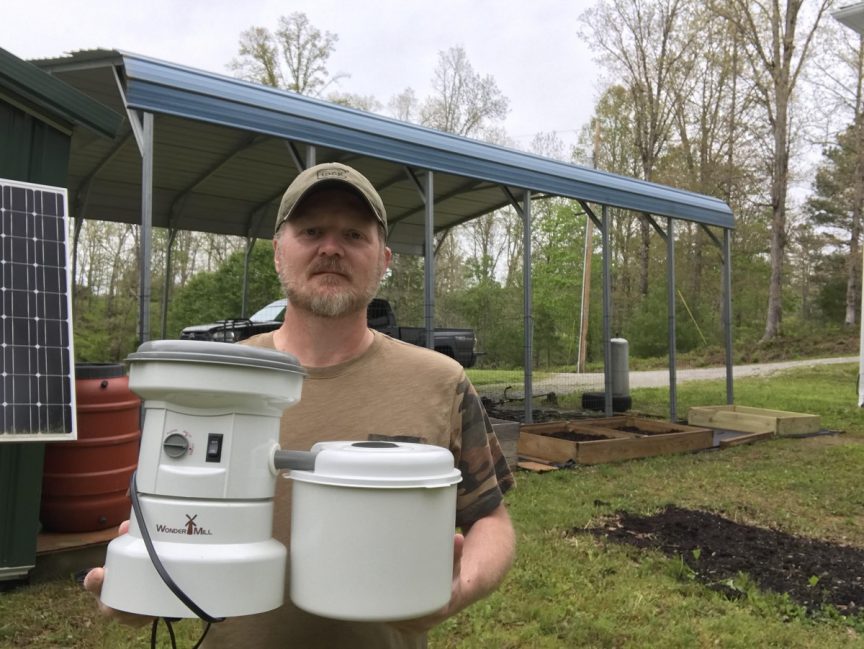
Advantages of an Electric Grain Mill
- Processes grain much faster
- Requires far less physical effort
- Produces flour quickly enough for regular baking
- Often produces fine, consistent flour in a single pass
- Useful for processing several pounds at one time
Disadvantages of an Electric Grain Mill
- Requires electricity
- May draw more power than a small backup system can comfortably supply
- Contains motors and electrical components that can fail
- May be difficult to repair after a long-term collapse
- Some models can only grind dry grains
Advantages of a Hand Grain Mill
- Works without electricity
- Can be used during a long-term power outage
- Usually has fewer complicated parts
- Can often be repaired more easily
- Allows you to grind only what you need
Disadvantages of a Hand Grain Mill
- Requires time and physical effort
- Some models need several passes to make fine flour
- Cheap models may move around while being cranked
- Small hoppers require frequent refilling
- Grinding enough flour for a large family can become exhausting
For someone who regularly bakes with freshly ground flour, the most practical setup is often an electric mill for everyday use and a quality manual mill as the non-electric backup.
For a prepper who can afford only one mill and is primarily concerned about a long-term grid-down emergency, I would lean toward a well-built hand mill.
What to Look for in a Hand Grain Mill
Before buying, consider the following:
Construction
Look for a sturdy body, strong drive shaft, solid handle, reliable bearings, and replaceable wear parts.
A mill does not have to weigh 50 pounds to be useful, but thin castings, weak clamps, and flimsy plastic components are not ideal for serious long-term use.
Mounting System
A mill that moves across the table while you crank it will become frustrating quickly.
Look for:
- A strong table clamp
- A double-clamp mounting system
- Holes that allow permanent bolting to a bench
- A mounting surface that will not flex or tip
A heavy mill is only as stable as the table holding it.
Type of Grinding Burrs
Different burrs are intended for different materials.
Stone or stone-style grinding heads are generally used for dry grains and producing fine flour.
Steel burrs are usually more versatile and may be suitable for:
- Dry grains
- Beans
- Corn
- Coffee
- Spices
- Oily seeds
- Nuts
- Nut butter
- Masa
That depends on the specific mill.
Do not grind nuts, oily seeds, wet grain, or other high-moisture food in a mill unless its manufacturer specifically says the mill and burrs are designed for it.
Oily material can clog or glaze grinding stones.
Fineness Adjustment
A good mill should let you adjust the output from coarse cracked grain to flour.
Consider what you plan to make:
- Cracked wheat cereal
- Cornmeal
- Grits or polenta
- Bread flour
- Pastry flour
- Bean flour
- Masa
A mill that works well for cracking corn may not produce fine bread flour efficiently.
Hopper Size
A tiny hopper is not necessarily a deal breaker, but repeatedly stopping to refill it becomes annoying.
A larger hopper is especially useful when milling several pounds of grain.
Replacement Parts
For a preparedness mill, consider buying:
- Replacement burrs or grinding plates
- Spare bearings or bushings when applicable
- Extra mounting hardware
- A replacement handle or grip
- Spare augers
- Manufacturer maintenance parts
A mill advertised as lasting a lifetime is still a machine. Machines wear, parts get lost, and accidents happen.
What It Will Actually Grind
Do not assume that every grain mill can process everything that fits into the hopper.
Before buying, find out whether it can handle:
- Wheat
- Corn
- Rice
- Rye
- Beans
- Small seeds
- Oily grains
- Nuts
- Coffee
- Wet or nixtamalized corn for masa
Buy the mill that matches the food you actually intend to store and grow.
The Grain Mills I Have Owned and Used
I have owned and used four different hand grain mills:
- Wonder Junior Deluxe
- Corona Landers grain mill
- Back to Basics grain mill
- Grizzly H7775 grain mill
They did not all perform at the same level.
Some were better for fine flour. Some were better for cracking corn and beans. Some were inexpensive backups that worked but required more effort and repeated grinding.
Wonder Junior Deluxe Plus: My Top Hand-Mill Pick
Affiliate disclosure: Some links in this article are affiliate links. I may earn a commission from qualifying purchases at no additional cost to you.
The model currently sold is generally called the Wonder Junior Deluxe Plus.
Of the hand mills I have personally used, the Wonder Junior has been my top choice.
Its main advantages include:
- Heavy-duty one-piece construction
- Strong double-clamp table mount
- Stone grinding heads for dry grains and fine flour
- Stainless-steel burrs for a broader range of foods
- Adjustable grind from cracked grain to fine flour
- A flour guide that helps reduce mess
- A hopper holding more than one quart
- The ability to bolt it permanently to a sturdy surface
- Optional accessories for drill or motor operation
The Deluxe version includes both stone grinding heads and stainless-steel burrs.
The stone heads are what I would normally use for dry wheat and fine flour.
The steel burrs add the ability to process items that could clog ordinary stone burrs, including many oily seeds, nuts, coffee, spices, and other foods permitted by the manufacturer.
The current Plus version also includes an auger intended for products such as masa and nut butter.
A Much Better Mounting System
One of the strongest features is the mounting system.
Cheap hand mills often have one clamp that loosens while the mill is being cranked. The mill begins sliding, twisting, or lifting off the edge of the table.
The Wonder Junior’s double-clamp system holds much more securely when attached to a strong surface.
If I planned to grind in the same location permanently, I would seriously consider bolting the mill directly to a heavy workbench.
That would give the strongest possible mounting arrangement.
Fine Flour Without Constant Regrinding
One of my main complaints with the Corona mill was the need to run grain through several times to produce flour fine enough for some types of baking.
The Wonder Junior did a much better job producing fine flour without forcing me to repeatedly regrind the entire batch.
The exact result will depend on:
- The grain
- The moisture content
- The burr being used
- The fineness adjustment
- How quickly the mill is cranked
Hand milling still requires real work. No hand-cranked machine changes that.
However, the smooth bearings, long handle, strong mount, and effective burrs make the work more productive.
Less Flour Thrown Across the Table
The flour guide directs the ground material toward the catch bowl.
That may sound like a minor feature until you have used a cheap mill that throws bits of grain and flour across the table and floor.
With some mills, I have had to secure a clean bag around the grinding head to control the mess.
A proper flour guide makes the process much cleaner.
Can the Wonder Junior Be Motorized?
The mill can be operated manually, and accessories have been offered that allow it to be powered with a drill or motor system.
Before attaching any motor, drill, pulley, or homemade power system:
- Read the current manufacturer instructions.
- Confirm the recommended operating speed.
- Use proper guards around belts and pulleys.
- Secure the mill to a strong surface.
- Understand how motorization affects the warranty.
A motor can save enormous effort, but a poorly designed conversion can damage the mill or injure someone.
I generally grind only the amount of flour I need, so manual operation remains practical for smaller batches.
Check the current price and availability of the Wonder Junior grain mill at Amazon.
The WonderMill Electric Grain Mill
WonderMill also makes an electric grain mill.
An electric impact mill is a different machine from the Wonder Junior hand mill.
Its main advantage is speed. It can turn grain into flour with very little physical effort.
That makes sense for someone who:
- Bakes bread regularly
- Grinds several pounds at a time
- Has reliable electricity
- Has a generator, solar system, or other backup power
- Wants fine flour quickly
However, electric mills are generally intended for dry grains and are not automatically suitable for oily seeds, nuts, or wet products.
Check the exact model instructions before milling anything other than approved dry grain.
An electric mill paired with a manual Wonder Junior or similar hand mill gives you convenience during normal times and a backup during a power outage.
Check the current price and availability of the WonderMill electric mill.
Corona Landers Grain Mill: Tough and Affordable
The Corona is a strong, simple, cast-iron hand mill.
It uses steel burrs and works well for:
- Cracking corn
- Grinding beans
- Making coarse meal
- Grinding many dry grains
- Processing nuts, seeds, or other permitted foods
It has been one of my most frequently used mills.
For the price, it is difficult to beat as a tough, basic piece of equipment.
Its main weakness is fine flour.
While it can grind wheat, I have often needed to run the grain through more than once and sift between passes to produce flour fine enough for certain breads and baked goods.
Other disadvantages I have experienced include:
- The hopper can loosen or come off during aggressive cranking.
- The mill sits low, making it difficult to fit a large bowl underneath.
- Ground material can scatter around the grinding head.
- Several passes may be needed for fine flour.
Despite those problems, it remains a useful, robust mill for someone on a limited budget.
I would consider it especially useful for cornmeal, cracked grain, beans, and emergency backup use.
Check the current price and availability of the Corona grain mill.
Back to Basics Grain Mill
The Back to Basics mill is lightweight and simple to use.
It can process grain, but it is not built to the same standard as the Wonder Junior or Country Living mills.
My biggest complaint has been the small hopper.
It requires frequent refilling, which slows the job considerably when processing more than a small amount.
The lighter construction also makes me question how well it would stand up to daily, long-term use during a collapse.
That does not make it useless.
It can still serve as:
- An inexpensive starter mill
- A compact backup
- A mill for occasional small batches
- A second unit kept at another location
Older Back to Basics mills still appear on the used market, but availability and replacement parts should be considered before relying on one as your only mill.
Grizzly H7775 Grain Mill
The Grizzly H7775 is another inexpensive cast-iron mill that I have owned.
It is not my first choice, but it is better than having no way to grind grain.
Its main disadvantages are:
- Small hopper
- Low grinding-head position
- Difficulty fitting a good-sized bowl underneath
- Lighter quality than the Corona
- More effort required to produce fine flour
The grinding plates are adjustable, and the mill can produce useful meal and cracked grain.
However, I would view it as an emergency backup rather than my primary bread-flour mill.
The H7775 is no longer widely promoted as a current Grizzly product, so anyone considering a used one should inspect it carefully and make sure all parts are present.
Country Living Grain Mill
The Country Living Grain Mill has an excellent reputation among people who use hand mills seriously.
It is built around a large flywheel and replaceable grinding plates and is intended as a durable, long-term machine.
The manufacturer currently offers accessories such as:
- A power bar
- A large corn-and-bean auger
- Motorization equipment
- Replacement parts
The major disadvantage is price.
It is a significant investment.
I have not personally owned one, so I cannot honestly give a side-by-side personal-use comparison against my Wonder Junior.
However, it deserves consideration by anyone who:
- Stores a large amount of wheat or corn
- Plans to mill regularly
- Wants a heavy machine that can be permanently mounted
- Wants current manufacturer support and available accessories
- Can justify the higher price
For someone who wants a mill that may be used for decades and passed down to the next generation, the Country Living is one of the serious options.
My Grain Mill Recommendations
Based on my own experience:
Best All-Around Hand Mill I Have Used
Wonder Junior Deluxe Plus
It combines fine-flour capability, a strong mounting system, multiple burr types, and the ability to process a wide range of foods.
Best Lower-Cost Heavy Cast-Iron Mill
Corona Landers
It is simple, rugged, and useful, especially for corn, beans, cracked grain, and coarser meal.
Best Budget Backup
Back to Basics or a similar basic hand mill
It will not compete with a premium mill, but it can provide another option if the primary mill breaks.
Premium Long-Term Option
Country Living Grain Mill
It is expensive, but it is designed as a serious long-term machine with current accessories and manufacturer support.
Best Everyday System
A good electric mill plus a quality hand-cranked backup
This gives you the speed of electricity and the security of a mill that works when the grid does not.
Practice Before You Need It
Do not buy a mill, place it unopened in the basement, and assume you are prepared.
Open it.
Wash or clean the appropriate parts according to the manufacturer’s instructions.
Mount it.
Grind wheat.
Make bread.
Grind corn.
Make cornbread.
Learn:
- How tightly to adjust the burrs
- How quickly to crank
- Whether the grain needs more than one pass
- How much flour you can realistically produce
- How to catch the flour without making a mess
- How to clean the mill
- Which parts might eventually need replacement
You may discover that hand grinding enough flour for one loaf of bread is a bigger job than you expected.
That is valuable information to learn now.
How to Grind Grain and Beans
Read the instructions for your particular mill first.
The general process is:
- Inspect the dry grain for stones, stems, insects, mold, and damaged kernels.
- Install the correct burrs for the food being processed.
- Mount the mill securely.
- Place a clean bowl or flour bin beneath the grinding head.
- Begin with a coarser setting if the grain is difficult to feed.
- Turn the handle at a steady speed.
- Adjust the burrs gradually until the desired consistency is reached.
- Sift and regrind the coarse material when necessary.
Do not overtighten the burrs so severely that they grind against each other without grain between them.
That can cause unnecessary wear and may contaminate the flour with burr material.
How to Sift and Regrind Flour
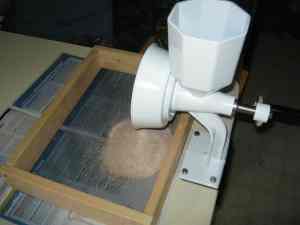
Some mills produce a mixture of fine flour and larger particles during the first pass.
Rather than running all the flour through the mill repeatedly, sift it.
The fine flour passes through the screen while the larger pieces remain behind.
Return only the coarse material to the hopper.
This:
- Saves effort
- Speeds up milling
- Reduces unnecessary regrinding
- Produces more consistent flour
Making a Simple Grain Sifter
I originally made a basic wooden sifter approximately 15 by 12 inches.
A better updated version can be made using:
- Untreated wood
- Stainless-steel food-grade mesh
- Food-safe fasteners or adhesive
- A smooth, cleanable finish approved for food-contact surfaces
Avoid ordinary fiberglass window screen, painted screen, galvanized hardware cloth, or unidentified metal mesh that was not designed for food contact.
You can also buy an inexpensive stainless-steel flour sieve and avoid building one.
Place clean parchment paper, a large tray, or another food-safe surface beneath the sifter.
Shake the flour gently through the mesh, collect the coarse pieces, and return them to the mill.
Buy Food-Grade Grain for Human Consumption
Never eat or grind seed grain that has been chemically treated for planting.
Seed grain may be treated with fungicides, insecticides, or other chemicals and is not intended for people or animals to eat.
Treated seed is often dyed a bright color, but you should never rely only on appearance.
Read the label and ask the seller.
You should also not assume that grain sold as livestock feed is automatically suitable for human consumption.
Feed grain may be handled, stored, tested, and cleaned under standards different from food intended for people.
It may contain:
- Dust and foreign material
- Animal contamination
- Higher levels of broken grain
- Mold or mycotoxins
- Chemical residues
- Stones and metal fragments
- Insects
The safest choice is grain clearly sold as:
- Food-grade
- For human consumption
- Untreated
- Suitable for milling or cooking
Food-grade whole grains can be purchased from:
- Food-storage suppliers
- Health-food stores
- Grain processors
- Food cooperatives
- Specialty farms
- Local farmers who can verify that the grain is untreated and intended for human food
What About Field-Run Grain?
Grain purchased directly from a farmer may be less expensive, but it may contain chaff, weed seeds, dirt, stones, insects, and broken kernels.
Before buying it, ask:
- Was the grain treated with any chemical after harvest?
- Was it grown from seed treated with chemicals that prohibit food use?
- Was it stored with fuel, pesticides, fertilizer, or other chemicals?
- Is it intended and suitable for human consumption?
- Has it been kept dry?
- Is there any evidence of mold, musty odor, or insect damage?
Saving money is not worth eating contaminated grain.
How to Clean Dry Grain Before Milling
Food-grade grain purchased from a reputable supplier usually requires little preparation beyond inspection.
Spread a small quantity on a light-colored tray and remove:
- Stones
- Sticks
- Husks
- Weed seeds
- Metal
- Dark or moldy kernels
- Insects
Use a dry screen, colander, fan, or gentle winnowing process to remove loose chaff and dust.
Do not routinely wash wheat berries immediately before putting them into a dry grain mill.
Moist grain can:
- Clog the mill
- Glaze stone burrs
- Cause flour to clump
- Promote rust
- Encourage mold during storage
If grain is dirty enough that it requires washing, I would question whether it is the right grain to use for flour.
It may be better used as a cooked whole grain—after appropriate washing and cooking—or replaced with cleaner food-grade grain.
Sprouted grain that will be milled must be dried completely using a controlled process before grinding.
Storing Whole Grain
Store dry grain in clean, food-grade containers.
Good options include:
- Mylar bags
- Food-grade plastic buckets
- Glass jars
- No. 10 cans
- Other containers specifically intended for dry food
Store the containers:
- In a cool location
- In a dry location
- Away from direct sunlight
- Off concrete floors
- Away from fuel, pesticides, paint, and chemicals
- Protected from insects and rodents
Label every container with:
- Type of grain
- Variety when known
- Purchase or packing date
- Supplier
- Any treatment used during storage
Inspect stored grain periodically for moisture, insects, damaged packaging, and unusual odors.
Store Grain, Not Large Quantities of Freshly Ground Flour
Whole-grain flour contains the bran and oil-rich germ.
Once the grain is ground, those oils are exposed to oxygen and the flour can become stale or rancid much faster than intact grain.
For the best flavor and storage efficiency:
- Keep most of your supply as whole grain.
- Grind only what you expect to use soon.
- Store extra flour in an airtight container.
- Refrigerate or freeze whole-grain flour for longer storage.
- Let cold flour return to room temperature before opening the container to reduce condensation.
This is another reason a dependable mill is so valuable.
You are storing a durable raw ingredient and producing fresh flour as needed.
Practice Cooking With Whole Grains
Buying wheat and a grain mill is not the same thing as knowing how to make bread.
Freshly milled whole-grain flour behaves differently from white all-purpose flour.
It absorbs water differently, contains bran that can interfere with gluten development, and may produce heavier bread until you learn how to work with it.
Practice making:
- Whole-wheat bread
- Biscuits
- Pancakes
- Tortillas
- Cornbread
- Cracked-wheat cereal
- Bean flour
- Homemade pasta
- Flatbread
Start by replacing part of the commercial flour in familiar recipes with freshly milled flour.
Increase the percentage as you learn how the flour behaves.
The Bottom Line
If whole grains are a major part of your survival food supply, a grain mill is not an optional kitchen gadget.
It is the tool that turns stored grain into familiar, usable food.
Of the hand mills I have owned and used, the Wonder Junior has been my favorite all-around choice because it:
- Produces fine flour efficiently
- Includes stone and steel grinding options
- Mounts securely
- Handles a broad range of foods
- Can operate without electricity
The Corona remains a solid lower-cost choice, especially for corn, beans, cracked grain, and emergency backup use.
The Country Living mill deserves consideration for someone who wants a premium, heavy-duty machine and can afford the investment.
Cheap mills have a place as backups, but I would not build my entire food plan around an untested bargain grinder.
Whatever mill you choose:
- Buy it before you need it.
- Use it regularly.
- Keep spare parts.
- Store only food-grade grain.
- Learn how to bake with what you grind.
A grain mill sitting unopened in a box is not preparedness. A mill you have used, maintained, and learned to cook with is.
What grain mill do you use, and what has your experience been with it? Share your recommendations in the comments below.
Grain Milling and Storage Resources
- WonderMill: Wonder Junior and Electric Grain Mills
- Country Living Grain Mills
- Utah State University Extension: Storing Wheat
- Utah State University Extension: Food Storage in the Home
- FDA: Grain Product Safety and Treated Grain
Food-Safety Disclaimer
This article provides general preparedness, grain-storage, and home-milling information. Follow the instructions supplied with your particular grain mill and food-storage products.
Buy grain clearly intended for human consumption. Never consume chemically treated seed grain. Grain sold for animal feed should not automatically be assumed safe or suitable for people.
Discard grain that is moldy, wet, chemically contaminated, strongly musty, or otherwise questionable. Grinding and baking do not reliably remove every chemical contaminant or toxin produced by mold.
Discover more from The Survivalist Blog by M.D. Creekmore
Subscribe to get the latest posts sent to your email.
Welcome back!!! Loved this article on grain mills. One suggestion: Freeze your fresh ground flour if not using it immediately because it starts to lose nutrients within 24 hours or less. Best to grind just before use. Also, freshly ground flour handles differently than packaged store flour due to the air in the flour. I have found that to use recipes that you have to weigh out the ingredients are best. So you need a good scale also.
Encourager