There is a lot of good information in the preparedness community.
There is also a lot of nonsense.
Some bad ideas started in survival fiction, were repeated on blogs and forums, and eventually became accepted as fact by people who never stopped to question whether the ideas made sense in the real world.
Fiction writers need drama.
They need enormous refugee hordes, lawless highways, isolated mountain retreats, gun battles, raiders, and a hero who always happens to have the right weapon at the right time.
That can make for an entertaining story.
It does not necessarily make a useful preparedness plan.
Real disasters are usually more complicated, less predictable, and far less cinematic.
People do not all react the same way. Governments do not disappear on a schedule. Cities do not always empty. Rural areas are not automatically safe. Owning guns does not make someone a tactical genius, and heading into the woods does not make an untrained family self-sufficient.
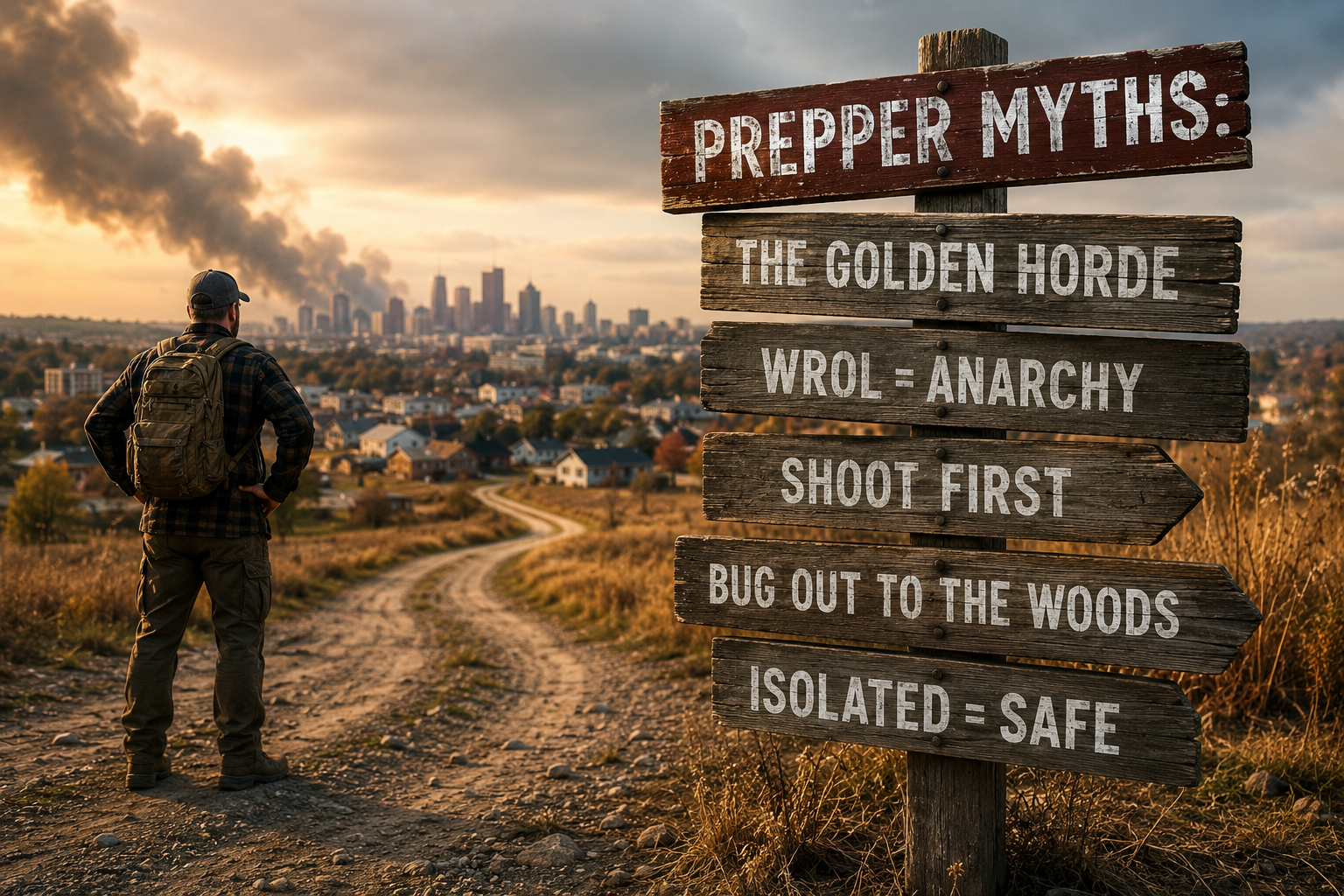
Here are five common pieces of prepper advice that deserve a closer look.
Prepper Myth Number One: The Golden Horde
The “golden horde” theory has been promoted for decades by survival authors, bloggers, forum members, and fiction writers.
The basic theory says that after an economic collapse, grid failure, or other major disaster, millions of desperate people will pour out of the cities and swarm across the countryside like locusts.
They will supposedly strip every rural store, farm, garden, chicken coop, and isolated home they encounter.
It sounds frightening.
It also assumes that millions of people will somehow:
- Leave at approximately the same time
- Travel in the same direction
- Walk enormous distances
- Know where rural supplies are located
- Move without fuel, food, water, maps, or transportation
- Remain organized enough to become one giant moving horde
That is not how large populations normally move.
People leave dangerous areas for different reasons and travel toward different destinations.
They may go to:
- Relatives
- Friends
- Hotels
- Government shelters
- Churches
- Nearby towns
- Other cities
- Work opportunities
- Areas where aid and services are available
Some people will leave the city for rural areas.
Some rural people will leave for towns and cities where they believe they can find employment, food, medical care, shelter, government assistance, or family support.
Others will stay exactly where they are until staying becomes impossible.
There is no reason to assume that everyone will follow the same pattern.
Localized Evacuations Are Different
A disaster specifically affecting an urban area can create a huge outward movement.
Hurricane Katrina is an obvious example.
New Orleans and surrounding areas experienced mandatory evacuation, severe flooding, destroyed housing, lost employment, and a massive displacement of residents into shelters and communities across numerous states.
But that movement did not resemble one organized army marching into isolated farmland.
People traveled along evacuation routes toward shelters, relatives, hotels, transportation hubs, and cities capable of receiving them.
That is far more realistic than the fictional picture of millions of people wandering randomly through the woods searching for prepper retreats.
Does That Mean Rural Areas Have Nothing to Fear?
No.
The fact that I do not expect one enormous golden horde does not mean rural areas will remain untouched.
Likely problems include:
- Heavy traffic along evacuation routes
- Fuel shortages
- Empty grocery stores
- Temporary camps
- Theft
- Burglary
- Desperate individuals and small groups
- Organized criminal gangs
- Targeted raids on farms, warehouses, stores, and isolated homes
Small groups can still be dangerous.
Ten organized criminals with vehicles, weapons, information, and a plan may present a greater threat than 10,000 exhausted people wandering around without food or transportation.
Rural communities near major cities, highways, distribution centers, and evacuation corridors may experience trouble sooner than more distant areas.
However, assigning a precise distance such as 25, 50, or 100 miles creates a false sense of certainty.
Roads, terrain, fuel availability, population density, local law enforcement, available shelter, and the type of disaster will matter more than a number drawn on a map.
Government Action May Matter More Than the Horde
An economic collapse does not automatically mean the government disappears.
A functioning government may become more involved, not less involved.
Possible actions could include:
- Rationing
- Price controls
- Travel restrictions
- Emergency declarations
- Curfews
- Priority distribution to densely populated areas
- Government purchasing or control of supplies
- Restrictions on fuel, food, or agricultural shipments
You may face more danger from shortages, regulation, economic controls, taxation, confiscation under color of emergency authority, or redirected supply chains than from a giant mass of people marching toward your house.
Do not base your entire security plan on one dramatic scenario.
Prepper Myth Number Two: WROL Means Permanent Anarchy
WROL stands for “without rule of law.”
Some survival writers describe WROL as though every disaster immediately produces a permanent nationwide free-for-all.
The police vanish.
The courts close forever.
Prisons empty.
Every neighbor becomes an enemy.
No one is ever held accountable for anything again.
A major disaster can absolutely create periods when normal law enforcement is unavailable or ineffective.
You may call 911 and receive no immediate response.
Police, firefighters, ambulances, hospitals, dispatch centers, and local government may be:
- Overwhelmed
- Understaffed
- Cut off by damaged roads
- Without communications
- Without fuel
- Dealing with more serious incidents elsewhere
That can create a temporary and localized loss of effective law enforcement.
But that is different from assuming that every law and authority has permanently disappeared.
Most People Want Order
Most people do not enjoy living in complete chaos.
They want:
- Safe streets
- Protection for their children
- Food distribution
- Fire protection
- Medical assistance
- Rules against theft, assault, rape, and murder
- Consequences for those who harm others
When official systems are weakened, people often create informal systems.
Neighbors check on one another.
Churches distribute food.
Volunteer groups clear roads.
People organize watches, share equipment, provide transportation, and look after children, elderly residents, and those with medical problems.
That does not mean everyone becomes friendly or that crime disappears.
Crime may increase substantially.
There may be looting, fraud, robbery, home invasions, violence, and exploitation.
The point is that widespread panic and permanent lawlessness are not the only possible human reactions.
Law May Become Local and Rough
If national or state systems fail, authority may shift downward.
The people enforcing order could include:
- County sheriffs
- Local police
- State police
- National Guard units
- Town governments
- Volunteer organizations
- Neighborhood groups
- Private security
- Informal community leaders
The resulting system may not be fair, consistent, or pleasant.
But some form of law and order will probably return because most communities cannot function without it.
Your preparedness plan should account for temporary gaps in emergency services without assuming that you will live forever in a Mad Max movie.
Prepper Myth Number Three: Shoot First and Ask Questions Later
This is where some preppers become confused and dangerously overconfident.
They imagine that after a major economic or social crisis, they will be free to shoot anyone who:
- Walks onto their property
- Looks suspicious
- Knocks on the door
- Asks for food
- Is seen near the garden
- Approaches the retreat
- Refuses to obey an order
That is not a serious security plan.
It is a prison sentence waiting to happen.
Unless the country enters a complete and prolonged state of civil war or total governmental collapse, laws concerning homicide, assault, firearms, self-defense, and use of force will continue to exist.
Even during a serious emergency, you may eventually have to explain every shot you fired.
The explanation may be given to:
- A responding deputy
- A prosecutor
- A grand jury
- A criminal jury
- A civil jury
- A local emergency authority
- The victim’s family
- Your own neighbors
Economic hardship does not automatically give anyone the right to kill a trespasser, thief, stranger, or hungry neighbor.
Deadly Force Is the Last Line
Your security plan should contain several layers before deadly force becomes necessary.
Those layers may include:
- Good locks
- Reinforced doors
- Fences and gates
- Exterior lighting
- Alarms
- Cameras
- Dogs
- Gravel approaches that make quiet movement difficult
- Clear views around the home
- Safe rooms
- Communication with neighbors
- Defensive spray where legal
- Verbal commands and de-escalation
- A safe way to retreat or create distance
Affiliate disclosure: Some links in this article are affiliate links. I may earn a commission from qualifying purchases at no additional cost to you.
Defensive spray can provide another option between doing nothing and using deadly force.
Nonlethal equipment is not harmless, and its possession or use may be regulated in some locations.
Learn how to use anything you carry, understand its limitations, and check your current state and local laws.
Know Local Law Enforcement Before the Disaster
It is a good idea to know your sheriff, deputies, police officers, firefighters, emergency-management personnel, and other local officials.
That does not mean making friends so they will cover up a bad shooting.
It means becoming a known, responsible member of the community before an emergency.
Attend local meetings.
Support volunteer organizations.
Learn who is responsible for emergency management.
Understand how your county handles evacuations, shelters, road closures, communications, and disaster response.
Those relationships may become important when normal systems are strained.
The person who uses unjustifiable force may still be prosecuted after the crisis ends.
Do not let survival fiction convince you otherwise.
Prepper Myth Number Four: Bugging Out to the Woods
One of the most common survival fantasies is loading the family, guns, ammunition, and a few bags of supplies into a vehicle and heading for the mountains.
Where in the mountains?
Most people have no idea.
They have no land, cabin, shelter, water source, food supply, sanitation plan, or permission to be there.
Their “bug-out location” is somebody else’s property, a national forest, a state park, or a vague spot they saw during a camping trip ten years ago.
That is not a plan.
It is running away.
Your Home Usually Contains Your Best Supplies
Your home probably contains:
- Shelter
- Stored food
- Water
- Tools
- Clothing
- Bedding
- Medical supplies
- Cooking equipment
- Documents
- Neighbors
- Familiar terrain
- Known escape routes
Leaving all that behind for an unknown patch of woods should not be your automatic response.
Living in the wilderness for several days with proper equipment can be difficult.
Living there for months or years while caring for children, elderly relatives, medical conditions, and people with no outdoor skills is another matter entirely.
Most people cannot hunt, trap, fish, forage, build shelter, maintain sanitation, preserve food, and avoid injury well enough to support a family indefinitely.
Watching survival television does not change that.
Sometimes You Absolutely Should Leave
Bugging in is not always the right choice.
You may need to evacuate because of:
- Wildfire
- Flooding
- Hurricane storm surge
- Chemical spill
- Dam failure
- Radiological release
- Nearby violence
- An unsafe or badly damaged home
- A mandatory evacuation order
The decision should be based on the actual threat—not on a blanket rule saying that bugging out is always foolish or always necessary.
A real evacuation plan includes:
- A known destination
- Permission to go there
- At least two routes
- Paper maps
- A vehicle maintained and fueled
- Supplies already packed
- A communication plan
- Plans for pets and livestock
- Trigger points that tell you when to leave
- A backup plan if roads are blocked
“Head north toward the mountains” is not enough.
For most threats, staying in a prepared home is better than becoming a refugee.
For threats that will destroy or overrun your location, leaving early may save your life.
Use logic and current information rather than emotion.
Prepper Myth Number Five: The Isolated Cabin Is Always Safest
Some survival writers say the safest possible location is a cabin as far away from other people as you can get.
I understand the appeal.
I have lived in isolated areas where my nearest neighbors were well over a mile away.
The peace and quiet were wonderful.
The isolation was also a weakness.
Every time I left for town, I wondered whether someone would break in and steal everything before I returned.
That was during normal times.
Isolation Works Both Ways
Living far away from everyone gives you privacy.
It also gives criminals privacy.
An isolated property may have:
- No witnesses
- Slow police response
- Slow fire response
- Long ambulance response times
- One road in and out
- No nearby help
- Poor cellular coverage
- Limited visibility from neighboring homes
If thieves occupy an isolated cabin, no one may notice.
If you are injured while cutting firewood, farming, repairing a roof, or using equipment, no one may hear you call for help.
If the house catches fire, the volunteer fire department may be many miles away.
If a group attacks, there may be no neighbor close enough to respond.
Isolation does not automatically equal security.
A Defensible Community Is Better Than Total Isolation
For many people, the best location is near a small town or established rural community.
Ideally, you would have:
- Enough land for a garden, orchard, livestock, and privacy
- Reliable water
- Wood or another independent heat source
- Several neighbors within practical helping distance
- Access to local roads without living directly on a major highway
- A nearby fire department
- A nearby clinic or medical provider
- Local tradespeople
- A church or other community network
Five to ten acres can provide plenty of room for a small homestead without placing you completely beyond the reach of help.
Do not go deeply into debt to obtain the perfect survival property.
A heavily mortgaged retreat can become another vulnerability if income disappears.
Build a Neighborhood Support Network
Your neighbors do not have to become part of a formal survival group.
Start with ordinary cooperation.
Learn:
- Who has medical training
- Who owns a tractor
- Who has a chainsaw
- Who can repair engines
- Who has livestock experience
- Who has a well
- Who has a generator
- Who is elderly or disabled and may need help
- Who can be trusted
Discuss simple agreements:
- Checking on one another during storms
- Reporting suspicious vehicles
- Sharing road information
- Helping clear fallen trees
- Calling for assistance
- Watching property when someone is away
Use Local Radios
Cellular service may fail or become overloaded.
Short-range radios can help neighbors communicate across a farm, rural road, or small community.
MURS radios can be useful for this purpose.
Check MURS radios and current availability here.
MURS is intended for short-distance personal and business communication and operates without an individually issued radio license when used according to FCC rules.
Actual range depends heavily on:
- Terrain
- Hills
- Trees
- Buildings
- Antenna height
- Radio quality
- Interference
Do not believe the enormous range numbers printed on radio packaging.
Buy the radios, test them at the actual properties, agree on a channel, and develop a simple communication plan.
Have a backup channel and a schedule for listening during an emergency.
What Should You Do Instead?
Do not build your preparedness plan around movie scenes and survival-fiction stereotypes.
Build it around:
- Your actual location
- Your family
- Your health
- Your finances
- Your neighbors
- Your local threats
- Your available skills
- Your realistic ability to leave or stay
A strong preparedness plan should include:
1. A Prepared Home
Store food, water, medication, sanitation supplies, lighting, backup heat, cooking fuel, tools, and emergency communications.
2. A Real Evacuation Plan
Know where you will go, why you would leave, when you would leave, and how you will get there.
3. Layered Security
Use barriers, lighting, locks, alarms, cameras, communication, neighborhood cooperation, and legally appropriate defensive tools.
4. Useful Skills
Learn first aid, food production, repair, water treatment, communication, cooking, sanitation, and basic security.
5. Community
Know the people around you.
A trusted neighbor with a tractor, chainsaw, medical kit, or radio may be more valuable than another expensive rifle hidden in the closet.
6. Flexibility
No plan survives every possible disaster unchanged.
Be ready to shelter in place, evacuate, assist others, change routes, relocate temporarily, or adapt when your original assumptions prove wrong.
The Real Threat Is False Confidence
The golden horde may not arrive.
The police may not disappear permanently.
Your isolated cabin may not be safer.
The woods may not feed your family.
Your gun may not solve the problem in front of you.
The most dangerous prepper myth is believing that one location, one weapon, one plan, or one dramatic theory has every answer.
Preparedness should make you more realistic—not more detached from reality.
Learn from history.
Study your local area.
Build relationships.
Develop more than one option.
Question anyone who tells you that every disaster will unfold exactly like his favorite survival novel.
The real world is complicated, and your preparedness plan needs to be flexible enough to survive it.
What other pieces of common prepper advice do you think are complete nonsense? Add your thoughts in the comments below.
Preparedness and Emergency-Planning Resources
- Ready.gov: Emergency Planning and Preparedness
- Ready.gov: Preparedness Starts at Home and in the Community
- Ready.gov: Family, Neighbor, and Evacuation Planning
- CDC: Hurricane Katrina Evacuation and Displacement
- National Conference of State Legislatures: State Self-Defense Laws
- Cornell Legal Information Institute: Self-Defense Overview
- FCC: Multi-Use Radio Service Rules
Legal and Safety Disclaimer
This article contains general preparedness opinions and should not be considered legal, tactical, financial, or emergency-management advice.
Self-defense laws, weapons laws, evacuation orders, emergency powers, radio rules, and use-of-force standards vary by jurisdiction and can change. Study the current laws where you live and consult a qualified attorney regarding specific legal questions.
Follow official evacuation and emergency instructions when remaining in place would expose you to wildfire, flooding, hazardous materials, violence, structural collapse, or another immediate danger.
A firearm or other defensive tool should be used only lawfully and responsibly. Avoid unnecessary confrontation, use de-escalation and barriers where practical, and seek professional defensive training.
Discover more from The Survivalist Blog by M.D. Creekmore
Subscribe to get the latest posts sent to your email.
Some of the best information and ideas that I have ever heard,
Thank you.
It’s good to have you back on this format. Now I can print and file these articles, good stuff.
Hey M.D.!!!,
Great “sane” article about “grand mistakes/misconceptions “!
Unfortunately, I’ve been living in a neighborhood where the residents just ‘stick to themselves’ or are ‘too busy for any real camaraderie! Few conversations beyond “Good Morning”. One neighbor i discussed emergency issues with stated “everyone will come together if a crisis arises”. Well, I’d, personally, like actual verification PRIOR! to any ‘events! I am not fond of the ‘wait & see’ scenario! I do live in a nice and calm neighborhood. So calm it seems almost like ostriches with their heads buried in the sand! Even at ThreeScore+12, I’m still planning on moving to a way-smaller town. I currently live in Clark County NV, Southern Nevada. Looking to move to Central/Eastern NV–smaller population but, a tighter-knit community. My current location has overgrown my liking! I’m hating the Vegas Valley!!!
Anyway, thanks for an informative piece!