Propane is one of the most useful emergency fuels available.
It stores well, burns cleanly when the appliance is operating correctly, and can power stoves, heaters, water heaters, generators, and other useful equipment.
But there is a lot of confusion about whether a propane stove can safely be used inside a house during a power outage.
The answer depends entirely on what kind of stove you are talking about.
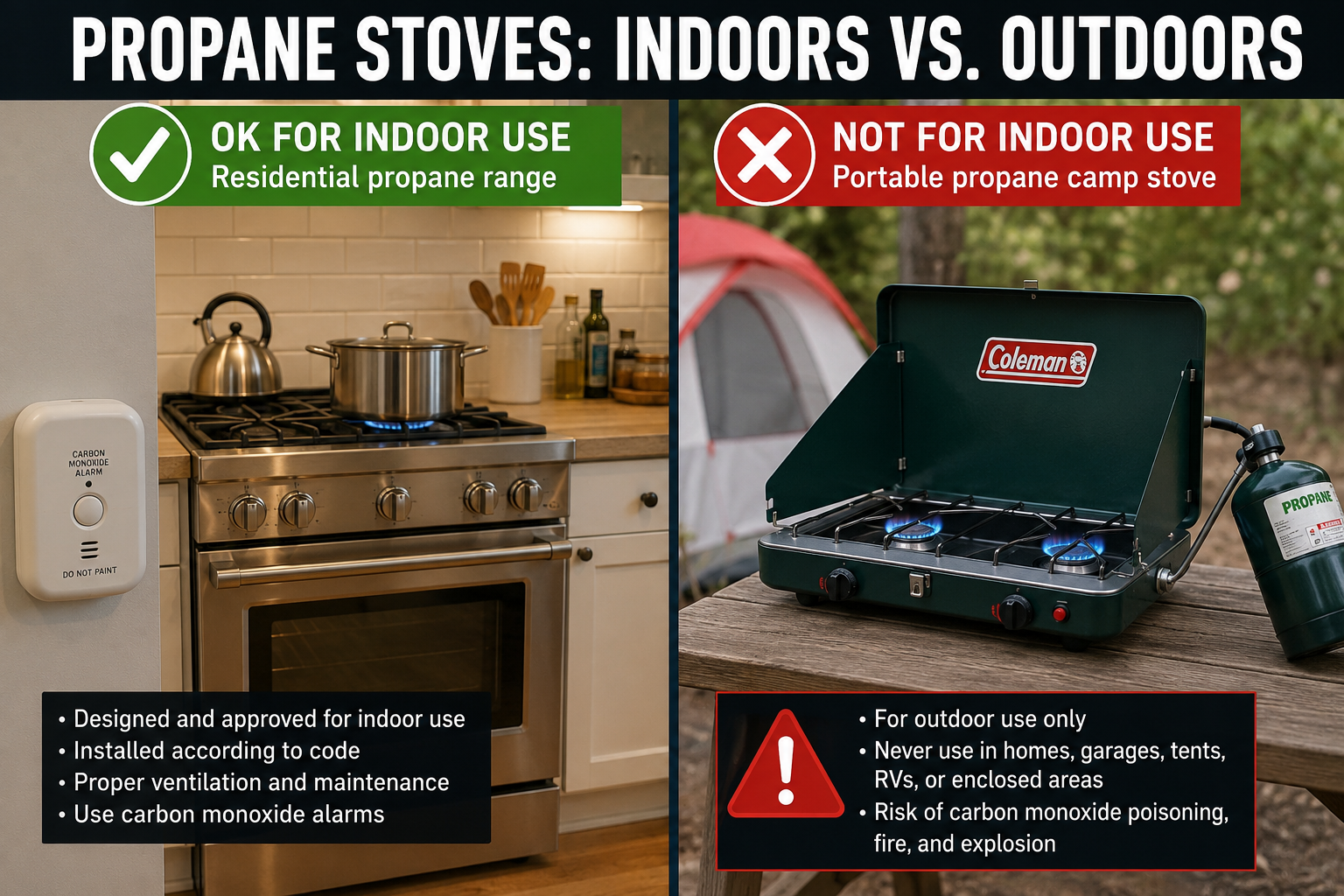
A permanently installed residential propane range designed for indoor use is completely different from a portable Coleman-style camp stove, outdoor cooker, turkey fryer, grill, or high-pressure propane burner.
A portable propane camp stove labeled for outdoor use should not be used inside your house, garage, basement, enclosed porch, vehicle, camper, shed, or tent.
Opening a window or cracking a door does not turn an outdoor appliance into an indoor appliance.
For indoor use, the appliance must be specifically designed, tested, approved, and labeled for that purpose—and it must be operated exactly as the manufacturer instructs.
Residential Propane Stove Versus Portable Camp Stove
The word stove causes much of the confusion.
People use the same word to describe several very different appliances:
- A permanently installed kitchen range
- A portable two-burner camping stove
- A high-pressure outdoor cooker
- A propane grill
- An indoor-rated portable heater
- An outdoor patio heater
- A wall-mounted propane heater
These appliances are not interchangeable.
A Residential Propane Range
A residential propane range is designed and certified for installation inside a home.
It should be:
- Installed according to the manufacturer’s instructions
- Connected using approved gas lines and fittings
- Installed according to local building and fuel-gas codes
- Maintained by a qualified technician
- Used with any ventilation required by the manufacturer
Millions of homes safely use propane or natural gas for everyday cooking.
That does not mean every appliance that burns propane is safe inside the house.
A Portable Propane Camping Stove
A portable camp stove is normally designed for outdoor cooking.
Examples include:
- Coleman two-burner propane camp stoves
- Tabletop propane grills
- Portable propane cookers
- Turkey fryers
- Fish cookers
- High-pressure outdoor burners
- Camping grills
These appliances may produce dangerous carbon monoxide, use an open flame near combustible materials, and lack the ventilation and safety systems required for indoor residential appliances.
If the stove or manual says:
- Outdoor use only
- Do not use in enclosed spaces
- Do not use in tents, campers, garages, or vehicles
then it should not be operated indoors.
The manufacturer’s instructions settle the question.
Why a Camp Stove Can Be Dangerous Indoors
There are three major risks:
- Carbon monoxide poisoning
- Fire and burns
- Propane leaks and explosions
Carbon Monoxide Poisoning
Carbon monoxide is a colorless and odorless gas produced when fuels such as propane, natural gas, gasoline, kerosene, wood, and charcoal do not burn completely.
You cannot see it.
You cannot smell it.
You may not realize you are being exposed until your judgment and physical ability are already impaired.
Early symptoms can resemble the flu or food poisoning:
- Headache
- Dizziness
- Weakness
- Nausea
- Vomiting
- Fatigue
- Shortness of breath
- Sleepiness
- Confusion
More serious exposure can cause:
- Loss of coordination
- Disorientation
- Loss of consciousness
- Brain damage
- Death
A sleeping person may never notice the early symptoms.
That is why no portable fuel-burning appliance should be operated while people are sleeping unless it is specifically designed and approved for that use—and the manufacturer expressly permits it.
Why Opening a Window Is Not Enough
One of the most common pieces of advice is:
Just crack a window and it will be fine.
That is not a reliable safety plan.
Air movement inside a building is affected by:
- Wind direction
- Outside temperature
- House pressure
- Exhaust fans
- Fireplaces and chimneys
- The location of doors and windows
- How tightly the home is sealed
- The appliance’s condition
- The amount of fuel being burned
An open window may provide some fresh air, but it does not guarantee that combustion gases are being removed.
Carbon monoxide can still collect in parts of the room or home.
A window also does nothing to correct:
- A damaged burner
- An incorrect regulator
- A blocked air intake
- A dirty stove
- An unstable flame
- A leaking propane connection
Ventilation is not permission to ignore an outdoor-use-only label.
Install Carbon Monoxide Alarms
Every home using fuel-burning appliances should have working carbon monoxide alarms.
Install alarms:
- On every level of the home
- Outside sleeping areas
- According to the alarm manufacturer’s placement instructions
Battery-operated alarms or alarms with battery backup are especially important during a power outage.
Test the alarms regularly and replace them according to the manufacturer’s schedule.
A carbon monoxide alarm provides another layer of protection, but it does not make an unsafe appliance safe.
What to Do if a Carbon Monoxide Alarm Sounds
If the alarm sounds or anyone develops possible carbon monoxide symptoms while a fuel-burning appliance is operating:
- Get everyone outside into fresh air immediately.
- Do not waste time searching for the cause.
- Call 911 or the fire department from outside.
- Do not reenter until emergency responders or another qualified professional says it is safe.
If you can shut off the appliance without delaying your exit or putting yourself in danger, do so.
Do not remain inside simply because the alarm stops sounding after a window is opened.
Fire and Burn Hazards
A portable propane stove has an exposed flame and becomes extremely hot.
Inside a home, it may be close to:
- Curtains
- Cabinets
- Paper towels
- Plastic containers
- Furniture
- Carpet
- Bedding
- Clothing
- Stored food
- Children and pets
Portable stoves can also be knocked over.
Large pots create additional instability, especially when filled with boiling water, soup, grease, or pressure-canning equipment.
Never place a portable stove on:
- A bed
- A plastic folding table
- A cardboard box
- A carpeted floor
- An unstable surface
- Any surface the manufacturer does not approve
Never leave cooking unattended.
Grease fires can spread quickly, especially when people are trying to cook in an improvised location during a power outage.
Propane Leaks
Propane is naturally odorless, but suppliers add a strong odorant often compared to rotten eggs or a skunk-like smell.
If you smell propane:
- Do not light the appliance.
- Do not operate electrical switches.
- Do not use a phone inside the affected area.
- Do not create a flame or spark.
- Get everyone away from the area.
- Shut off the propane supply only if you can do it safely.
- Call the propane supplier, fire department, or 911 from a safe location.
Do not return until the area has been declared safe.
Check hoses, regulators, seals, valves, and connections before use.
Never test for a propane leak with a match, lighter, or other flame.
Can I Use a Coleman Propane Stove Indoors?
No—not when the stove is labeled for outdoor use only.
Coleman currently states that its Classic two-burner propane camping stove is designed for outdoor use and should not be operated inside:
- A house
- A garage
- An enclosed patio
- A tent
- Another enclosed area
That remains true even if you open a window or garage door.
A Coleman camp stove is an excellent outdoor emergency-cooking option.
It is not a replacement for a residential kitchen range.
Can I Use a Propane Stove in a Garage?
An attached garage is not outdoors.
Neither is a garage with the overhead door partially or fully open.
Carbon monoxide can accumulate inside the garage and enter the house through:
- An interior door
- Wall openings
- Attic spaces
- Heating and cooling systems
- Other air leaks
A garage also contains gasoline, paint, solvents, vehicles, lawn equipment, cardboard, and other combustible materials.
Do not use an outdoor propane camp stove or high-pressure cooker in a garage.
Can I Use a Propane Stove in a Tent?
No outdoor-use-only camp stove should be used inside a tent.
Tents combine several dangers:
- Limited ventilation
- Highly combustible fabric
- Sleeping people
- Little room around the flame
- Unstable flooring
- Sleeping bags and clothing close to the stove
A flame can ignite a tent in seconds.
Carbon monoxide can also build up before anyone realizes there is a problem.
Cook outside and place the stove far enough from the tent that heat, sparks, spilled fuel, or a flare-up cannot ignite it.
Can I Use One Inside an RV or Camper?
A recreational vehicle may contain a permanently installed propane range that was specifically designed and installed for that RV.
That appliance should be operated according to the RV and appliance manuals.
Do not assume that the presence of an installed propane range means you can bring an outdoor camp stove inside the RV.
A portable Coleman-style camping stove labeled for outdoor use should remain outside.
Outdoor Propane Cookers Are Definitely Outdoor Appliances
Large propane burners such as turkey fryers, fish cookers, stockpot burners, and high-pressure Bayou Classic-style cookers should never be used indoors.
These appliances can produce tens of thousands of BTUs and are designed for open outdoor cooking.
They are commonly used for:
- Boiling large stockpots
- Cooking fish
- Frying turkeys
- Heating canners
- Cooking for groups
They should be placed outdoors on a stable, noncombustible surface, well away from:
- The house
- Garages
- Deck railings
- Dry grass
- Vehicles
- Overhanging roofs
- Doors, windows, and air intakes
What About Indoor-Rated Propane Heaters?
Some portable propane heaters are specifically designed and certified for limited indoor use.
The Mr. Heater Buddy family is a well-known example in the United States.
These models may include:
- An oxygen-depletion sensor
- A tip-over shutoff
- A high-temperature safety shutoff
That does not mean every propane heater is safe indoors.
It also does not mean an indoor-rated heater can be used anywhere, in any manner, without ventilation.
Before operating one:
- Confirm that the exact model is labeled for residential indoor use.
- Read the complete manual.
- Provide the ventilation required by the manufacturer.
- Observe all clearance requirements.
- Keep it on a stable, noncombustible surface.
- Use a working carbon monoxide alarm.
- Check state and local restrictions.
- Never use it while sleeping unless the manual expressly permits it.
Some jurisdictions restrict or prohibit unvented propane heaters indoors even when a manufacturer markets the heater as indoor-safe.
An outdoor patio heater, construction heater, torpedo heater, cooker, or radiant tank-top heater should never be treated as an indoor residential heater.
Never Use a Cooking Stove to Heat the House
A propane or natural-gas kitchen range is intended for cooking.
Do not leave burners operating simply to warm the room.
Do not use the oven with the door open as a space heater.
Using a cooking appliance for heat can increase the risk of:
- Carbon monoxide exposure
- Fire
- Burns
- Indoor air-quality problems
- Accidental contact with the flame
Heat the home only with equipment designed and approved for indoor heating.
Safer Emergency Cooking Options During a Power Outage
The safest approach is to prepare several cooking options before the electricity goes out.
1. Use Your Installed Residential Gas Range
If you already have a properly installed propane or natural-gas range, it may continue to function during a power outage.
Some cooktops with electronic ignition can be lit manually. Others cannot.
Modern gas ovens often depend on electricity for ignition and safety controls and may not work without power.
Check the appliance manual before the emergency.
Never attempt to bypass a safety system or modify the appliance.
2. Cook Outdoors With a Propane Camp Stove
A two-burner propane camp stove is one of the most practical emergency cooking tools available.
Set up a dedicated outdoor cooking area on a stable surface.
Keep it away from:
- Doors
- Windows
- Air-conditioning intakes
- Dry grass
- Wood siding
- Overhanging roofs
- Children and pets
An open-sided metal-roof shelter can provide protection from rain while maintaining outdoor airflow.
Do not enclose the sides with tarps while the stove is burning.
3. Use an Electric Hot Plate or Induction Cooker
An electric hot plate, rice cooker, slow cooker, or induction burner can operate from:
- A properly sized portable power station
- A solar power system
- A permanently installed backup-power system
- A generator operating safely outdoors
Induction cooking can be especially efficient, but it requires compatible cookware and enough electrical power.
4. Use a Properly Installed Wood Stove
A wood stove with a flat cooking surface can provide both heat and limited cooking capability.
It must be:
- Properly installed
- Connected to an appropriate chimney
- Kept clear of combustible materials
- Inspected and maintained
- Used with working smoke and carbon monoxide alarms
5. Eat Foods That Require Little or No Cooking
Every emergency food supply should include foods that can be eaten without using fuel.
Examples include:
- Canned meat
- Canned beans
- Canned fruit
- Peanut butter
- Crackers
- Ready-to-eat meals
- Granola
- Dried fruit
- Nuts
- Shelf-stable milk
Cooking fuel is a limited resource. You do not need to burn propane for every meal.
Before Using Any Propane Appliance
Inspect the appliance before every use.
Check:
- The hose
- The regulator
- The control knobs
- The burner
- The propane connection
- The cylinder
- The support legs and cooking surface
Do not use an appliance with:
- A cracked hose
- A damaged regulator
- Heavy rust
- A bent or unstable frame
- A blocked burner
- A leaking connection
- Missing safety components
Keep the burner clean and free of grease, food, insects, spider webs, and debris.
Use only the regulator, hose, cylinder size, and fuel specified by the manufacturer.
Do not create homemade propane adapters or modify the appliance unless the conversion is specifically approved by the manufacturer.
Supervise Cooking
Never leave a propane stove unattended while it is burning.
Remain close enough to respond immediately if:
- A pot boils over
- Grease ignites
- The wind blows out the flame
- The stove tips
- A hose begins leaking
- A child or pet approaches
Keep pot handles turned away from the edge.
Do not wear loose clothing around the flame.
Keep children and pets out of the cooking area.
Keep Fire Protection Nearby
Have an appropriate fire extinguisher within reach of the outdoor cooking area.
For ordinary household cooking, a multipurpose extinguisher rated for common combustibles, flammable liquids, and energized electrical equipment is useful.
A kitchen-rated extinguisher may be appropriate for cooking-oil fires.
Never throw water on burning grease.
Know how to shut off the propane supply quickly.
Recommended Emergency Propane Equipment
Affiliate disclosure: Some links below are affiliate links. I may earn a commission from qualifying purchases at no additional cost to you.
Coleman Classic Two-Burner Propane Camp Stove
The Coleman Classic is a practical outdoor cooking stove for camping and power outages.
It has two independently controlled burners and folding wind panels.
It is an outdoor-use-only appliance.
Check the Coleman propane camp stove at Amazon.
Bayou Classic Outdoor Propane Cooker
A high-pressure outdoor cooker is useful for large stockpots, water-bath canners, boiling water, and cooking for a group.
These high-output burners must be used outdoors.
Check the Bayou Classic outdoor cooker at Amazon.
Mr. Heater Buddy
Some Mr. Heater Buddy models are designed and certified for limited indoor heating use in the United States.
Confirm that the exact model is approved for the location where you intend to use it, follow the manual, provide the required ventilation, and use working carbon monoxide alarms.
This is a heater, not a cooking stove.
Check the Mr. Heater Buddy at Amazon.
The Bottom Line
Propane can be an excellent emergency fuel, but the appliance determines where and how it can be used.
A properly installed residential propane range is designed for indoor cooking.
A portable Coleman-style camp stove, outdoor cooker, turkey fryer, grill, or high-pressure burner is not.
Do not rely on an open window, cracked garage door, or carbon monoxide alarm to make an outdoor appliance safe indoors.
Use outdoor appliances outdoors.
Use indoor appliances only in the locations and manner permitted by their manufacturer.
Install smoke and carbon monoxide alarms, maintain your equipment, inspect propane connections, and prepare more than one safe way to cook before the power goes out.
What emergency cooking setup do you use during a power outage? Share your experience in the comments below.
Propane and Carbon Monoxide Safety Sources
- CPSC: Carbon Monoxide Questions and Answers
- CPSC: Portable Heaters and Camping Equipment
- CPSC: Protect Your Family From Carbon Monoxide
- Propane Education and Research Council: Safe Appliance Operation
- Important Propane Safety Information
- Coleman Classic Propane Camping Stove
- Mr. Heater: What Indoor-Safe Means
Safety Disclaimer
This article is intended for general preparedness and safety information. Always read and follow the instructions supplied with your specific propane appliance.
Appliance classifications, ventilation requirements, clearances, approved locations, fuel connections, and local laws vary. Consult the appliance manufacturer, propane supplier, fire department, building-code office, or a qualified propane technician when you are uncertain.
Never use an outdoor-use-only propane appliance indoors. Never ignore a propane odor or carbon monoxide alarm. Leave the area immediately and contact emergency services from a safe location.
Discover more from The Survivalist Blog by M.D. Creekmore
Subscribe to get the latest posts sent to your email.
Leave a Reply