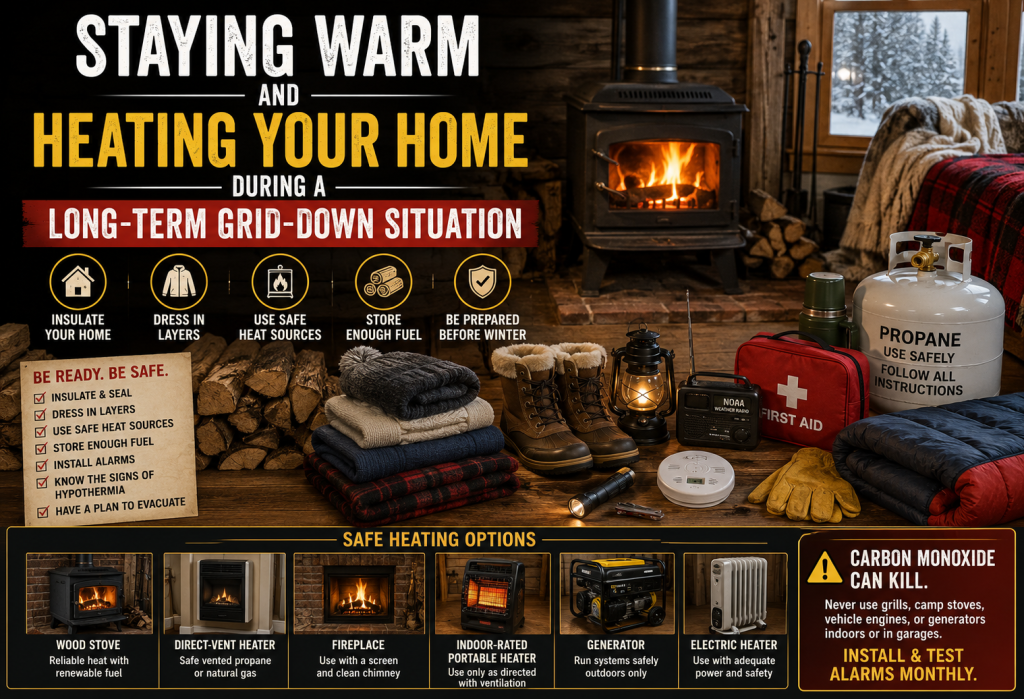
Heating your home during a long-term winter power outage may be one of the most difficult preparedness problems you will ever face.
When the lights go out in July, you are uncomfortable. When the power goes out during a week of freezing temperatures, you can be in real danger.
Hypothermia begins when the body’s core temperature falls below 95°F. It affects the brain, coordination, judgment, heart, nervous system, and other organs. Left untreated, it can be fatal.
That means your winter preparedness plan must do more than keep the pipes from freezing. It must keep the people inside the home warm enough to remain safe.
You may need to do that for several hours, several days, or much longer—without depending entirely on electricity.
The good news is that staying warm does not necessarily require heating every room in the house to 72 degrees.
The real goal is to:
- Keep everyone dry
- Reduce heat loss from the home
- Dress properly
- Concentrate everyone in a smaller warm area
- Use safe backup heat
- Manage fuel carefully
- Recognize hypothermia before it becomes deadly
Important: Fuel-burning heaters, fireplaces, wood stoves, generators, and propane systems can cause fires, explosions, or deadly carbon-monoxide poisoning when installed or used incorrectly. Follow all manufacturer instructions and applicable codes. Use qualified professionals for permanent fuel systems and appliances.
Your Location Determines the Size of the Problem
The first thing to consider is where you live.
A winter power outage on Tennessee’s Cumberland Plateau is serious. The same outage in Montana, North Dakota, Alaska, or the higher elevations of the Rocky Mountains may become life-threatening much faster.
Think about:
- Your normal winter temperatures
- The lowest temperatures your area has experienced
- How often ice and snow bring down power lines
- How long rural roads may remain blocked
- How quickly utility crews can reach your area
- Whether your home depends on a well pump
- Whether older adults, infants, or medically vulnerable people live with you
The colder the climate, the more redundancy you need.
Someone living where winter temperatures rarely drop below 25°F may be able to get through an outage with warm clothing, sleeping bags, and a small indoor-rated heater.
Someone living where temperatures regularly fall below zero needs a serious heating system, a dependable fuel supply, and a backup plan if that system fails.
Winter temperatures should be considered when choosing a home, homestead, or retreat property. Heating requirements affect everything from construction and fuel storage to transportation and the amount of work required to maintain the property.
Prepare the House Before the Power Goes Out
The cheapest heat is the heat you do not lose.
Insulation and air sealing help every day, not only during a grid-down emergency. They lower normal heating costs and allow the home to remain warm longer after the primary heat source stops working.
Add Insulation Where It Matters
If you are building or remodeling, insulate for your climate and consider going beyond the minimum required by local building codes where doing so makes sense.
Attics are often one of the largest sources of heat loss.
My home was already reasonably well insulated for my area, but I had additional blown-in insulation installed in the attic to bring it to approximately R-60.
Your house may need a different amount. Have the attic inspected before adding insulation, especially around:
- Chimneys
- Recessed lights
- Electrical wiring
- Bathroom exhaust vents
- Soffit ventilation
- Existing moisture problems
Insulation should not block required ventilation or be packed against equipment that requires clearance.
Seal Doors and Windows
Check exterior doors and windows for drafts.
Useful improvements include:
- Weatherstripping
- Door sweeps
- Caulk around stationary gaps
- Temporary clear window film
- Storm windows
- Insulated curtains
- Heavy shades
Open curtains on sunny windows during the day to allow solar heat inside. Close them before dark to reduce heat loss.
Heavy curtains also reduce the amount of light visible from outside, which may be useful during a prolonged emergency when you do not want to advertise that your home is occupied and supplied.
Do not cover windows or doors needed as emergency exits.
Know Your House
Before winter, locate:
- The main water shutoff
- The electrical breaker panel
- Gas or propane shutoffs
- Fire extinguishers
- Smoke alarms
- Carbon-monoxide alarms
- Fireplace dampers
- Outside appliance vents
Keep outside vents clear of snow, ice, leaves, and other debris. A blocked furnace or fireplace vent can cause carbon monoxide to enter the home.
Dress for the Cold Inside the House
Do not burn through your fuel supply trying to maintain normal short-sleeve indoor temperatures.
Dress for the cold even when you are indoors.
The key is layering.
Base Layer
The layer closest to your body should help manage moisture. Damp clothing pulls heat away from the body.
Use:
- Thermal underwear
- Merino wool
- Synthetic moisture-wicking clothing
- Dry, comfortable sleep clothing
Insulating Layer
Add one or more layers that trap warm air:
- Fleece
- Wool sweaters
- Insulated pants
- Quilted jackets
- Coveralls
Outer Layer
When going outside, use an outer layer that blocks wind and protects the insulating layers from snow or rain.
Wet clothing should be removed and dried as quickly as possible.
Protect Your Head, Hands, and Feet
Wear:
- A stocking cap or insulated hat
- Glove liners with insulated gloves
- Dry socks
- Insulated boots or indoor booties
- A scarf or neck gaiter
Do not cram too many socks into tight boots. Restricting circulation can make your feet colder.
Keep several changes of dry socks available. Feet that become damp from sweat can become dangerously cold later.
Use Cold-Weather Sleeping Bags and Insulation Underneath You
Every household member should have a warm sleeping bag, several blankets, or another dependable sleep system.
A sleeping bag’s temperature rating should be lower than the temperature you realistically expect inside the unheated home.
Do not overlook the surface underneath you.
A mattress, foam sleeping pad, folded blankets, rugs, or even flattened cardboard can reduce heat loss into a cold floor.
During a prolonged outage, you may sleep in:
- Thermal underwear
- Dry socks
- A warm hat
- Loose insulating layers
Avoid breathing inside the sleeping bag all night. Moisture from your breath can dampen the insulation and reduce its effectiveness.
Heat People, Not the Entire House
A smaller space is easier to keep warm than an entire home.
If fuel is limited, choose one room as the household’s primary warm room.
The best room generally has:
- Few exterior walls
- Few or small windows
- A low ceiling
- Enough space for everyone
- Access to the safe backup heat source
- A working smoke alarm
- A working carbon-monoxide alarm when fuel is burned
Close doors to unused rooms.
Hang heavy blankets over open doorways when needed, but keep all fabric at least three feet from heaters, stoves, fireplaces, lamps, candles, and other heat sources.
Keep one clear exit from the warm room at all times.
The Urban Igloo
If you have no dependable backup heater, you can reduce the space you are trying to warm even further.
I call this the urban igloo.
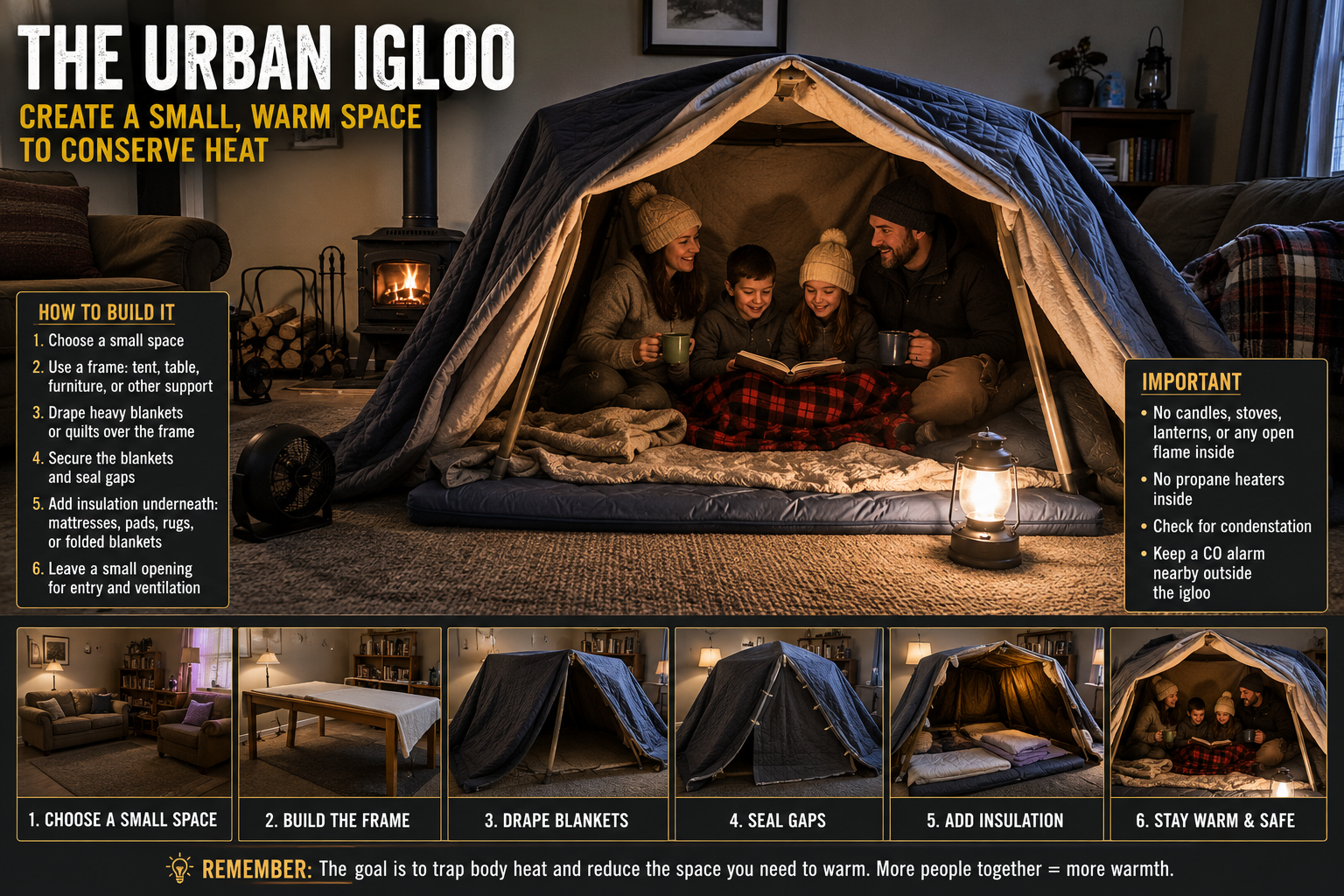
It also works in a rural home, but it may be especially useful in an apartment or public housing where installing a wood stove, propane tank, or permanent wall heater is not an option.
You can use:
- A small camping tent set up inside the warm room
- A kitchen table covered with quilts and blankets
- A temporary frame made from furniture
- Mattresses, foam pads, rugs, or folded blankets underneath
Drape heavy blankets or quilts over the frame and down toward the floor. Leave a small opening for ventilation and entry.
The small enclosed area will hold body heat better than the entire room. Several people inside will generate more warmth than one person alone.
This does not create unlimited heat. It is simply another insulating layer around the people who need to stay warm.
Never put a candle, stove, lantern, propane heater, kerosene heater, charcoal, or another fuel-burning device inside an indoor tent or blanket shelter.
Do not place an electric space heater inside it or close enough to ignite the fabric.
Check periodically for condensation and damp bedding. Moisture will eventually make you colder.
The Best Alternative Heat Sources
The best backup heat source depends on your property, climate, budget, available fuel, and whether you own or rent.
1. A Properly Installed Wood Stove
For someone living on rural property with access to firewood, a wood stove is one of the most practical long-term heating options.
A wood stove:
- Does not require grid electricity
- Can produce substantial heat
- May provide a cooking surface
- Uses a locally available renewable fuel
- Can continue operating for as long as you can supply dry firewood
The stove and chimney must be properly sized, installed, and inspected.
Have the stove, chimney, connector pipe, and flue inspected before each heating season and cleaned as needed.
Keep combustible material at least three feet away unless the appliance installation instructions and approved heat shielding specify otherwise.
Burn only the fuel approved for the stove. Do not burn:
- Trash
- Pressure-treated lumber
- Painted wood
- Gasoline
- Used motor oil
- Plastic
Place cooled ashes into a metal container with a tight-fitting lid and store it outdoors away from the house and anything that can burn.
2. A Direct-Vent Propane or Natural-Gas Heater
A direct-vent wall heater can be an excellent backup because it pulls combustion air from outside and vents exhaust outside.
Some models use a standing pilot or millivolt control and can operate without household electricity. Others need electricity for controls, ignition, or a blower.
Verify how the exact model operates before buying it.
Have the heater, fuel tank, piping, regulator, venting, and shutoffs installed and serviced by qualified professionals.
Do not install, modify, coat, or bury a propane tank yourself.
Underground propane tanks require approved construction, corrosion protection, clearances, inspection, and installation according to current codes.
If you smell propane or hear gas escaping:
- Do not operate lights, phones, appliances, or electrical switches.
- Extinguish smoking materials and open flames only if it is safe to do so.
- Leave the building immediately.
- Call the propane supplier, fire department, or 911 from outside and away from the suspected leak.
- Do not return until a qualified professional says it is safe.
3. A Fireplace
A properly maintained fireplace can provide some emergency heat and a place to burn locally available firewood.
Use a metal or tempered-glass screen to control sparks.
Have the chimney inspected and cleaned before the heating season.
Keep furniture, bedding, curtains, rugs, firewood, and other combustible material away from the opening.
Never leave a fireplace burning unattended or while everyone is asleep.
An open fireplace may not heat a home as efficiently as a quality wood stove, but it is considerably better than having no backup heat at all.
4. An Indoor-Rated Portable Fuel Heater
Some portable propane and kerosene heaters are specifically designed and listed for indoor use.
Others are outdoor appliances and can produce deadly carbon monoxide when brought inside.
Only use a heater that is:
- Specifically approved and labeled for indoor use
- Legal in your jurisdiction
- Used with the fuel specified by the manufacturer
- Operated exactly as instructed
- Placed on a stable, level surface
- Kept at least three feet from anything combustible
- Used in a room with required ventilation
- Monitored by working smoke and carbon-monoxide alarms
Never operate a portable fuel-burning heater while everyone is sleeping unless the appliance is permanently installed and specifically intended for that use.
Never improvise fuel hoses, regulators, fittings, or cylinder connections.
5. Electric Space Heaters
If electricity is still available from the grid, a properly sized generator, or another sufficient power source, an electric space heater may help warm one room.
Electric resistance heaters consume a great deal of electricity, so they are usually impractical for small battery power stations.
When using an electric space heater:
- Plug it directly into a wall outlet.
- Do not use a power strip.
- Do not run the cord under a rug.
- Keep it at least three feet from anything that can burn.
- Place it on a stable, level surface.
- Keep children and pets away.
- Turn it off before leaving the room or going to sleep.
6. A Generator Running the Existing Heating System
Many gas, oil, and propane furnaces still require electricity for blowers, controls, pumps, and ignition.
A properly sized generator may be able to run the furnace, but it must be connected safely.
Never backfeed electricity into a home through a dryer outlet or improvised cord.
Have an electrician install an approved transfer switch or other code-compliant connection.
Run portable generators outdoors only, at least 20 feet from occupied buildings, with the exhaust directed away from doors, windows, vents, and neighboring homes.
Never operate a generator in a:
- House
- Garage
- Basement
- Crawlspace
- Shed
- Porch
- Carport
Opening the garage door does not make generator use inside the garage safe.
Never Use These Methods to Heat Your Home
Do not use:
- A charcoal grill indoors
- A propane grill indoors
- A camp stove as a heater
- An outdoor patio heater indoors
- A gasoline generator indoors
- A vehicle idling in an attached garage
- A gas oven or kitchen range to heat the room
- An improvised open fire inside the home
These can cause carbon-monoxide poisoning, fire, explosion, or oxygen depletion.
Carbon monoxide has no color, smell, or taste. You may become confused or unconscious before realizing anything is wrong.
Smoke and Carbon-Monoxide Alarms
Every home using a fuel-burning furnace, heater, fireplace, stove, generator, or appliance needs working smoke and carbon-monoxide alarms.
Use alarms with battery backup so they continue operating during an outage.
Smoke alarms should be installed:
- Inside every bedroom
- Outside each sleeping area
- On every level of the home
- In the basement
Carbon-monoxide alarms should be installed on every level and outside sleeping areas according to the manufacturer’s instructions and applicable codes.
Test all alarms monthly.
Do not remove the battery because an alarm becomes inconvenient.
If a carbon-monoxide alarm sounds:
- Get everyone outside immediately.
- Call 911 or the fire department from outside.
- Do not reenter until emergency personnel say the home is safe.
Plan and Store Your Fuel Before Winter
A heater without fuel is expensive furniture.
Estimate how much fuel your heating system consumes during cold weather.
Do not depend entirely on the advertised maximum burn time. Actual consumption depends on:
- Outside temperature
- Home insulation
- Wind
- Size of the heated area
- Thermostat setting
- Fuel quality
- Condition and efficiency of the appliance
Firewood
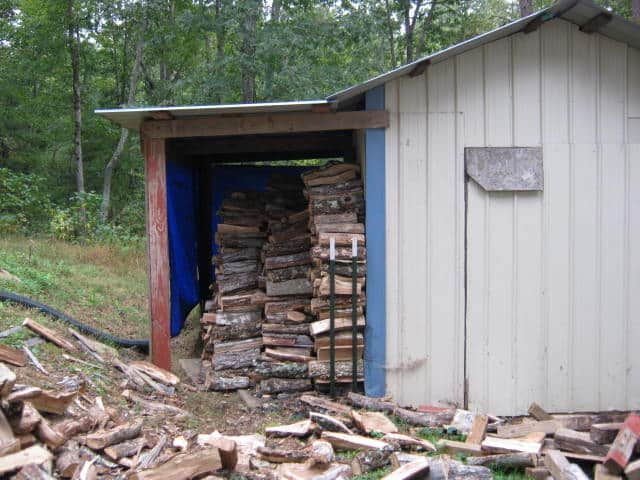
If wood is your primary backup, have at least one heating season’s supply cut, split, dried, and stacked before winter.
Two or three years of firewood gives you additional security and allows newly cut wood time to season.
Keep firewood:
- Off the ground
- Protected from rain and snow
- Ventilated so it can continue drying
- A safe distance from the house
- Away from termites and other pests
Rotate the supply by burning the oldest dry wood first.
If you expect to produce your own firewood, you will need:
- A chainsaw
- Spare chains
- Files or sharpening equipment
- Bar oil
- Fuel and two-cycle oil when applicable
- Protective chaps
- Helmet and face protection
- Hearing protection
- Gloves
- Splitting maul or axe
- Wedges
- A hand saw as backup
Take chainsaw training and do not work alone when felling trees.
Propane
Check the propane-tank gauge regularly and arrange delivery before the tank becomes nearly empty.
Do not assume a delivery truck will reach you after an ice storm, bridge closure, or extended regional outage.
If a propane system runs completely out of gas, contact the propane supplier. The system may require a leak check by a qualified professional before it is returned to service.
Know the Signs of Hypothermia
Hypothermia can occur indoors, especially among older adults, infants, people with mobility limitations, and people who are sick or undernourished.
Warning signs in adults include:
- Shivering
- Exhaustion
- Confusion
- Fumbling hands
- Loss of coordination
- Memory loss
- Slurred speech
- Drowsiness
Babies may have cold, bright-red skin and very low energy.
A person who stops shivering despite continued cold exposure may be getting worse—not better.
Hypothermia is a medical emergency.
If someone has a temperature below 95°F or shows serious symptoms:
- Call 911 or seek medical care immediately.
- Move the person into a warm room or shelter.
- Remove wet clothing.
- Warm the center of the body first—the chest, neck, head, and groin.
- Use dry blankets, clothing, towels, or skin-to-skin contact under loose layers.
- Give a warm nonalcoholic drink only if the person is fully awake and able to swallow.
- Handle a severely cold person gently.
Do not give alcohol. Alcohol can increase heat loss and interfere with judgment.
Know When to Leave
Preparedness does not mean remaining inside an unsafe house merely to prove that you can.
Consider going to a warming center, hotel, family member’s home, or another safe location if:
- You cannot keep the home warm enough.
- Your backup heater fails.
- You run low on fuel.
- A carbon-monoxide alarm sounds.
- You smell propane or natural gas.
- The home suffers structural damage.
- Someone begins showing signs of hypothermia.
- An infant, older adult, or medically vulnerable person is at risk.
Leave early when possible.
Waiting until the roads are blocked, the house is freezing, and everyone is exhausted makes evacuation much more dangerous.
Winter Grid-Down Heating Checklist
- Insulation appropriate for the climate
- Weatherstripping and window coverings
- Warm clothing for every household member
- Cold-weather sleeping bags and blankets
- Insulating sleeping pads
- A designated warm room
- Materials for an indoor tent or urban igloo
- A professionally installed backup heating system
- An adequate stored fuel supply
- Smoke alarms with battery backup
- Carbon-monoxide alarms with battery backup
- Fire extinguishers
- Flashlights and headlamps
- A battery-powered radio
- Stored food and water
- Prescription medications
- A vehicle with enough fuel to evacuate
- The location of the nearest warming center
Official Safety Resources
- CDC: Preventing Hypothermia
- CDC: Staying Safe During a Power Outage
- CPSC: Generator, Furnace, and Space-Heater Safety
- U.S. Fire Administration: Heating Fire Safety
- Propane Safety Information
Recommended Reading
- Wood Heat: A Practical Guide to Heating Your Home With Wood
- Keeping Warm in Hard Times
- Homeowner’s Complete Guide to the Chainsaw
The Bottom Line
Staying warm during a winter power outage begins long before the electricity fails.
Insulate and seal the house. Store warm clothing and sleeping bags. Choose one room to heat. Install a safe backup heat source. Maintain smoke and carbon-monoxide alarms. Store enough fuel, and learn how to use the equipment before winter.
For a short outage, blankets, layers, and an indoor tent may be enough.
For a long-term grid-down emergency in a cold climate, you need a dependable heating appliance and a renewable or substantial stored fuel supply.
Do not take shortcuts with propane, chimneys, generators, or improvised heaters. Cold is dangerous, but an unsafe heating method can kill an entire household much faster.
Prepare now, test your system, and know when conditions have become too dangerous to remain in the home.
How do you plan to heat your home during an extended winter power outage? Add your experience and suggestions in the comments below.
Discover more from The Survivalist Blog by M.D. Creekmore
Subscribe to get the latest posts sent to your email.
Leave a Reply