Most preppers make the same mistake when they start building a medical supply.
They prepare almost entirely for gunshot wounds, knife wounds, severe bleeding, and other dramatic trauma caused by violence or accidents.
There is nothing wrong with owning tourniquets, pressure dressings, chest seals, clotting gauze, and other trauma supplies. Those things can save a life.
But there has to be a balance.
The medical problems you are most likely to face during an emergency are many of the same problems people face right now:
- Colds, flu, and respiratory infections
- Fever
- Vomiting and diarrhea
- Dehydration
- Food poisoning
- Skin infections
- Cuts, punctures, burns, and sprains
- Dental pain and infection
- Allergic reactions
- Heat exhaustion and heat stroke
- Hypothermia and frostbite
- Arthritis and chronic pain
- Pregnancy and childbirth
- Complications from diabetes, asthma, heart disease, and other chronic medical conditions
- Running out of prescription medication
Most of these problems are relatively easy to handle while pharmacies, doctors, dentists, clinics, ambulances, and hospitals are functioning normally.
After even a short-term disaster, the medical system can become overwhelmed. Roads may be blocked, pharmacies may be closed, hospitals may be operating on backup power, and emergency services may be unable to reach everyone who needs help.
Now imagine what medical care could look like after an EMP, nuclear attack, long-term grid failure, major cyberattack, widespread pandemic, severe economic collapse, or another event that disrupts normal medical care for months or years.
This article is about that kind of situation.
I am talking about the end of the world as we know it—the kind of collapse where there may be no doctor, no functioning hospital, no pharmacy, no ambulance, no 911 response, and no reasonable expectation that professional help is coming.
Under those conditions, people may eventually face choices that would be unthinkable today.
The time to build your medical knowledge, supplies, reference library, and contacts is now, while the medical system still works.
Prevention Is Your First Line of Defense
The best medical emergency is the one you prevent.
You cannot prevent every injury or illness, but improving your health now can make you far more capable during a disaster.
Prevention includes:
- Getting into reasonable physical condition
- Eating a better diet
- Controlling chronic medical conditions
- Taking care of existing dental problems
- Maintaining good sanitation
- Practicing safe food handling
- Getting enough sleep
- Using protective equipment while working
- Avoiding unnecessary accidents
- Keeping important medical records organized
Some preppers buy the best equipment they can find, pack a 70-pound bug-out bag, and believe they are ready for anything.
Unfortunately, some of them cannot carry that bag 100 yards without stopping for a snack and a 30-minute nap.
You do not have to become an Olympic athlete. You should, however, work toward being physically capable of walking, carrying supplies, cutting firewood, working in a garden, moving an injured person, and performing the physical labor that a long emergency may require.
A Practical Prepper Fitness Standard
No single fitness standard will be right for everyone. Age, disability, chronic illness, previous injuries, and your current physical condition all have to be considered.
Still, it helps to have goals.
The fitness goals I originally suggested were:
- Walk or run one mile in approximately 15 minutes, or 20 minutes if you are over 50
- Complete 35 push-ups, or 25 if you are over 50
- Complete 40 sit-ups, or 30 if you are over 50
- Bench press at least one repetition using 75 percent of your body weight, or 50 percent if you are over 50
These are rough preparedness goals, not medical requirements.
If you have been inactive for years, do not attempt to meet all of them in one afternoon. Start slowly and work your way up.
At the very least, you should strive to:
- Walk a reasonable distance without becoming exhausted
- Climb several flights of stairs
- Carry groceries, water, firewood, and other practical loads
- Get up and down from the ground without assistance
- Perform basic work around your home or homestead
- Maintain enough balance and flexibility to reduce your risk of falling
Current general activity guidance recommends that most adults work toward at least 150 minutes of moderate physical activity each week, along with muscle-strengthening activity on at least two days.
Some activity is better than none.
Strength Training
You do not have to join a gym or purchase expensive equipment to build strength.
Body-weight exercises can improve strength and muscular endurance when performed regularly.
Useful exercises include:
- Push-ups
- Sit-ups or another appropriate core exercise
- Jumping jacks
- Squats
- Pull-ups or assisted pull-ups
- Lunges
- Heel raises
- Resistance-band exercises
- Loaded carries
One simple routine I have used is:
- Push-ups—three sets until proper form begins to fail
- Pull-ups—three sets until proper form begins to fail
- Sit-ups or another core exercise—three sets
- Squats—three sets
- Jumping jacks—50 repetitions
Rest between sets and stop before poor form causes an injury.
Cardiovascular Endurance
Cardiovascular endurance allows you to walk, run, work, and carry supplies longer without becoming exhausted.
Some people prefer running. Others prefer walking at a brisk pace. Cycling, swimming, hiking, and working around a homestead can also build endurance.
One method I have used is interval training:
- Walk approximately 200 yards
- Run or move quickly for approximately 100 yards
- Return to walking
- Repeat for one to three miles, depending on your condition
You can adjust the distance, speed, and recovery time to fit your ability.
The key is to make a reasonable plan and stick with it.
Start With a Better Diet
Eating better does not have to be complicated.
There are three basic rules that will improve most diets:
- Reduce refined sugar.
- Reduce highly processed and prepackaged food.
- Reduce fast food.
Eat more:
- Vegetables
- Fruit
- Beans and lentils
- Whole grains
- Eggs
- Fish
- Chicken
- Meat in reasonable amounts
- Nuts and seeds when appropriate
- Healthy cooking oils
Fresh food from your own garden or orchard has the added benefit of teaching you how to grow food before a disaster forces you to learn.
Farmers markets are another good source of locally produced food.
Do not build a long-term food supply that conflicts with your medical needs. Someone with diabetes, kidney disease, severe food allergies, high blood pressure, or another diet-sensitive condition needs a food-storage plan built around that condition.
Vitamins, Minerals, Herbs, and Supplements
Vitamins, minerals, and herbal preparations have a place in many preparedness plans.
What you store should depend on what you already use, what you tolerate, and what you understand.
Products commonly discussed in preparedness and traditional medicine include:
- Basic multivitamins
- Vitamin C
- Vitamin D
- Electrolyte powders
- Turmeric or curcumin
- Fish oil
- Garlic
- Hawthorn
- Cinnamon
- Ginger
- Peppermint
- Milk thistle
- Valerian root
- Melatonin
- St. John’s wort
Some people use hawthorn for cardiovascular support, garlic and soluble fiber as part of a cholesterol-conscious plan, cinnamon for blood-sugar support, ginger and peppermint for digestive discomfort, milk thistle for liver support, and valerian or melatonin for sleep.
St. John’s wort is commonly associated with mood support, but it is also known for interacting with many medications.
Red yeast rice is another product commonly promoted for cholesterol, but its active compounds can behave similarly to prescription statin drugs and may have similar risks and interactions.
Keep a written list of every supplement, prescription, and over-the-counter medicine you use. That information could be important if another person has to make medical decisions for you.
Get Enough Sleep and Control Stress
Most adults generally need approximately seven to nine hours of sleep each night.
That amount of sleep may be difficult during a disaster, but going into the emergency already exhausted will not improve your chances.
Sleep deprivation affects:
- Judgment
- Memory
- Coordination
- Reaction time
- Mood
- Decision-making
- Physical performance
A regular sleep schedule can help. Go to bed and get up at roughly the same time whenever possible.
Stress also has to be controlled.
Once you open your eyes to everything going wrong in the world, it is easy to become obsessed with politics, war, crime, economic problems, shortages, and preparing for every possible disaster.
Take time to step away from it.
Go fishing. Sit on the porch. Spend time with family. Watch a movie. Work in the garden. Take a drive. Pray.
You cannot spend every day living as though the world will end tomorrow without eventually wearing yourself down.
Get Medical Training
Medical supplies are far more useful when someone knows how to use them.
Every capable adult and older teenager in the household should consider completing:
- Basic first aid
- CPR and AED training
- Bleeding-control training
Additional useful training includes:
- Wilderness first aid
- Wilderness first responder
- Emergency medical responder training
- Emergency medical technician training
- Community emergency response training
- Infant and child first aid
Training teaches more than how to perform a procedure. It helps you recognize what is happening, decide what needs to be done first, and avoid making the situation worse.
If you belong to a preparedness group, having a doctor, registered nurse, paramedic, EMT, pharmacist, dentist, veterinarian, or another medically trained person in the group would be extremely valuable.
A trained medical professional with limited equipment can do far more than an untrained person standing in front of a warehouse full of supplies.
Sex Still Happens After the Grid Goes Down
Men and women will still form relationships, seek comfort, have sex, become pregnant, and give birth after a collapse.
Ignoring that fact does not make it go away.
A long-term preparedness plan should include:
- Condoms
- Prescription birth control
- Pregnancy tests
- Menstrual supplies
- Prenatal vitamins when appropriate
- Pregnancy and childbirth references
- Infant-feeding supplies
- Diapers and wipes
Condoms can help prevent pregnancy and reduce the spread of sexually transmitted infections, but they need to be stored correctly and rotated.
A vasectomy may be worth considering for a man who is certain he does not want future children. It should be treated as permanent, and it does not prevent sexually transmitted infections.
Women and couples concerned about maintaining birth control during a long disruption may want to learn about long-acting methods such as IUDs and contraceptive implants.
Depending on the specific product, those methods can remain effective for several years without requiring monthly trips to the pharmacy.
Pregnancy planning should also include:
- Copies of prenatal records
- Emergency transportation plans
- Contact information for maternity-care providers
- Necessary prescription medication
- Supplies for the mother and infant
- Reliable childbirth references
Build Your Medical Supplies in Layers
I recommend dividing medical supplies into separate levels.
Level One: Everyday First Aid
This is the equipment you will use most often.
- Adhesive bandages in several sizes
- Sterile gauze pads
- Nonstick wound dressings
- Rolled gauze
- Medical tape
- Elastic compression bandages
- Triangular bandages
- Commercial splints
- Instant cold packs
- Burn dressings
- Nitrile examination gloves
- CPR face shield
- Medical scissors
- Tweezers
- Digital thermometers
- Saline wound wash
- Soap
- Hand sanitizer
- Antiseptic supplies
- Petroleum jelly
- Antibiotic ointment
- Hydrocortisone cream
- Calamine lotion
- Emergency blankets
- Flashlights or headlamps
- Notebook and permanent marker
- A current first-aid reference
Level Two: Serious Bleeding and Trauma
- Commercial tourniquets from reputable manufacturers
- Compressed gauze
- Hemostatic gauze
- Pressure dressings
- Large trauma dressings
- Chest seals
- Trauma shears
- Emergency blankets
- Nitrile gloves
- Eye protection
- Permanent markers
Keep trauma supplies in a clearly marked kit that can be reached quickly.
A tourniquet locked in the basement behind six months of food storage will not help someone who is bleeding to death in the workshop or driveway.
Practice with dedicated training equipment rather than repeatedly tightening the tourniquet you intend to use during a real emergency.
Level Three: Personal and Chronic-Care Supplies
- Prescription medication
- A written medication list with dosages
- Blood-pressure monitor
- Blood-glucose meter and testing supplies
- Insulin and cooling equipment when needed
- Inhalers and spacers
- Prescribed epinephrine auto-injectors
- Spare eyeglasses
- Hearing aids and batteries
- Denture supplies
- Mobility aids
- Medical-device batteries and chargers
- Special dietary supplies
Create a medical information sheet for every member of the household.
Include:
- Full name and date of birth
- Medical conditions
- Medication allergies
- Current prescriptions
- Dosages and schedules
- Doctor and pharmacy contact information
- Emergency contacts
- Medical-device information
Keep one copy in a waterproof bag and update it whenever something changes.
Level Four: Advanced Medical Supplies
A long-term preparedness group may want advanced equipment available for a trained person to use.
Possible supplies include:
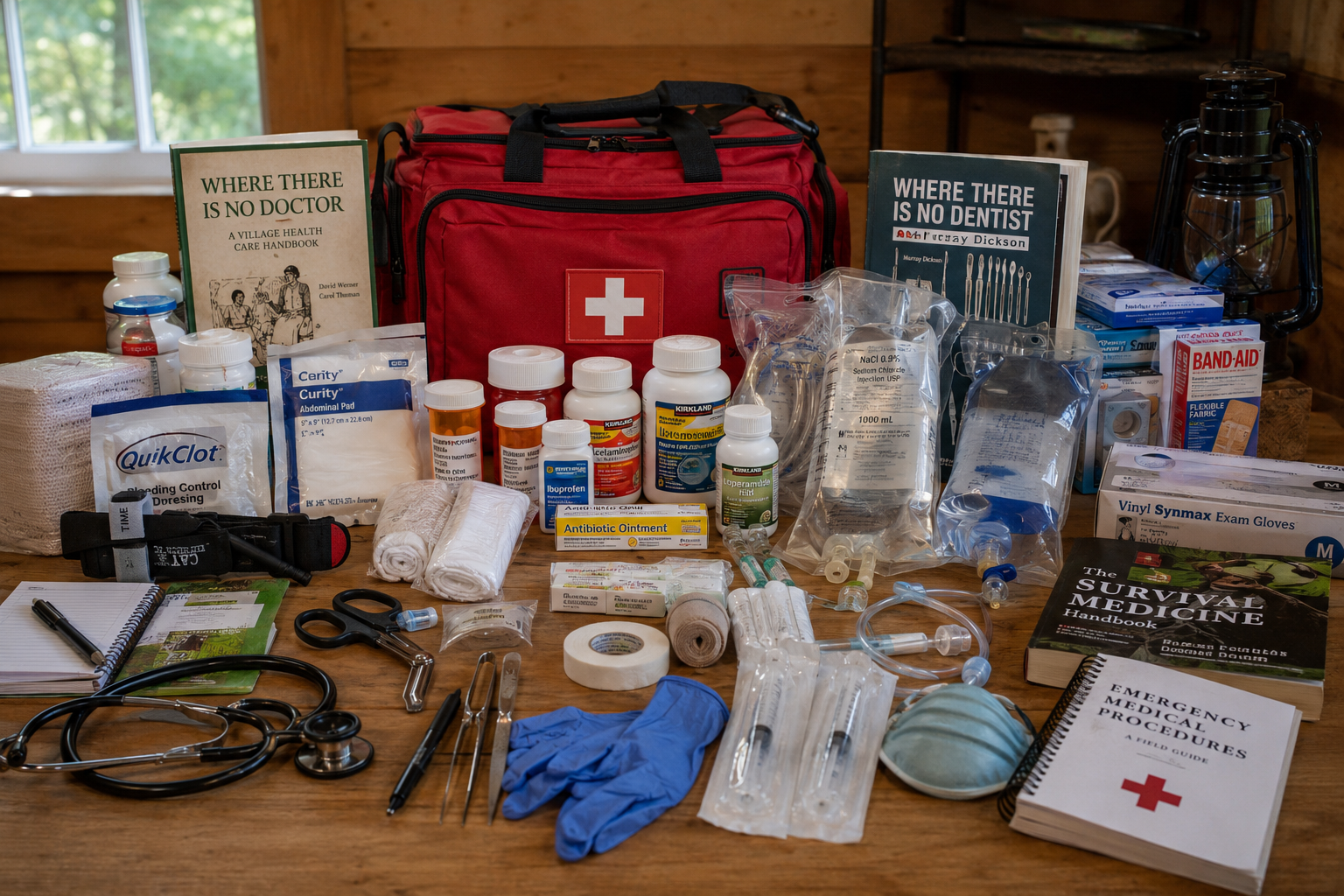
- Basic surgical instruments
- Suture material and wound-closure supplies
- Scalpels
- Sterile needles and syringes
- IV fluids and administration equipment
- Injectable medications obtained legally
- Prescription antibiotics obtained legally
- Local anesthetic for qualified users
- Stethoscope
- Pulse oximeter
- Blood-pressure equipment
- Advanced airway equipment
- Urinary catheters
- Large quantities of sterile dressings
- Large quantities of personal protective equipment
- Crutches, walkers, wheelchairs, and stretchers
There is nothing wrong with owning advanced medical supplies.
The problem is believing that buying a suture kit makes someone a surgeon or that watching one video qualifies a person to start an IV.
Stock advanced equipment with the intention of obtaining the training yourself or making the supplies available to someone who already has the necessary knowledge.
In a total collapse, a trained doctor, nurse, paramedic, dentist, or veterinarian may still be alive and willing to help but have no equipment.
Having the supplies could make all the difference.
Over-the-Counter Medications
Ordinary illnesses will not disappear after a collapse.
Possible over-the-counter medication categories include:
- Pain and fever reducers
- Anti-inflammatory medication
- Oral antihistamines
- Anti-diarrheal medication
- Constipation relief
- Antacids and acid-reducing medication
- Cough and cold medication
- Motion-sickness medication
- Oral rehydration salts and electrolyte packets
- Topical antifungal medication
- Hydrocortisone cream
- Calamine lotion
- Saline nasal spray
- Topical pain-relief products
- Temporary dental-filling material
Learn the active ingredients rather than looking only at the brand name.
Many cold and flu medicines contain the same pain reliever found in separate tablets. Combining several products can result in accidentally taking too much of one ingredient.
Date and rotate your medical supplies just as you rotate stored food.
Store medicine according to its label and protect it from excessive heat, moisture, light, and freezing.
Prescription Medications
If someone depends on a daily prescription medication, that medication is a critical preparedness supply.
Keep an updated written list containing:
- Medication name
- Generic name
- Dosage
- How often it is taken
- Why it is prescribed
- Prescribing doctor
- Pharmacy information
- Known drug allergies
Build the largest legal reserve you can reasonably maintain.
Some insurance plans and state emergency-refill laws may allow additional medication under certain circumstances. Pharmacies may also be able to arrange vacation refills or synchronize prescriptions.
Some medications require refrigeration or protection from freezing.
Possible backup equipment includes:
- Insulated medical cooler
- Chemical cold packs
- Temperature monitor
- Battery power station
- Generator
- Solar charging equipment
- A backup location with refrigeration
Learn the safe storage requirements before the power goes out.
Shelf Life of Medications
Medication shelf life is more complicated than believing every medicine becomes poisonous at midnight on its expiration date—or believing that every drug remains useful forever.
The expiration date represents the period during which the manufacturer guarantees the product’s strength, quality, purity, and stability when it is stored under the labeled conditions.
The federal Shelf-Life Extension Program has found that selected lots of medication stored under controlled conditions can sometimes remain stable beyond their original expiration dates.
That does not mean every bottle stored in a hot bathroom, damp basement, garage, or vehicle remains effective.
Important factors include:
- The specific medication
- The formulation
- Packaging
- Whether the seal remains intact
- Temperature
- Humidity
- Exposure to light
- Previous storage conditions
While replacement medication remains available, rotate your supply and use unexpired products.
After a total collapse, an expired medication may be the only medication available.
At that point, the question may become:
What is the risk of using this medication compared with the risk of leaving the illness untreated?
There is no single answer that applies to every medicine or every illness.
Federal testing of professionally stored stockpile medication does not prove that every home-stored drug remains usable. However, I would rather understand the limitations and have a possible option available than automatically discard everything based solely on a printed date.
Fish Antibiotics in a True Collapse
The use of fish antibiotics has been debated in preparedness circles for decades.
At various times, sellers have marketed aquarium products labeled with familiar antibiotic names such as:
- Amoxicillin
- Cephalexin
- Doxycycline
- Ciprofloxacin
- Metronidazole
- Azithromycin
Some products were advertised in the same strengths commonly seen in human prescriptions.
That does not prove every bottle contained medication identical to a human prescription, nor does it guarantee current products are manufactured, tested, stored, or labeled to the same standards.
The FDA has taken enforcement action against companies selling unapproved antimicrobial products for aquarium fish. Many products that were once easy to purchase are now more difficult to find.
But this article is not about choosing a fish antibiotic instead of visiting a doctor on a normal Tuesday.
It is about facing a potentially fatal infection when there is no doctor, no hospital, no pharmacy, no telemedicine, no legitimate human medication, and no help coming.
If I were dying from what appeared to be a serious bacterial infection under those conditions, I would rather have a carefully researched possible antibiotic available than have no option whatsoever.
That does not make the decision safe.
It means the danger of doing nothing may eventually become greater than the danger of using what is available.
Anyone preparing for that possibility needs to understand:
- Not every infection is bacterial.
- Antibiotics do not treat viruses.
- Different bacteria respond to different antibiotics.
- The wrong antibiotic may accomplish nothing.
- Some people have severe or fatal allergic reactions.
- Antibiotics can interact with other medications and medical conditions.
- Incorrect use contributes to antibiotic resistance.
- Symptoms that look like an infection may have another cause.
- The label on an animal product does not guarantee its identity, purity, or strength.
This article does not attempt to provide antibiotic dosing or diagnosis instructions.
The best option is to obtain legitimate emergency medication, reliable medical references, and medical training while those options are still available.
Dental Preparedness
A severe toothache can make it impossible to sleep, eat, work, or think clearly.
Dental infections can also become serious medical problems.
Known dental problems should be handled before an emergency whenever possible.
Brush, floss, and maintain regular dental care while dentists and supplies remain available.
A basic dental emergency kit may contain:
- Toothbrushes
- Toothpaste
- Dental floss
- Dental wax
- Temporary filling material such as Temparin or Cavit
- Gauze
- Nitrile gloves
- Small dental mirror
- Tweezers
- Cotton
- Toothpicks
- Cold packs
- Oral pain-relief products
- Appropriate pain medication
- Clove oil
- Hand sanitizer
- A current dental emergency reference
Temporary filling material may buy time, but it does not permanently repair decay, cure an infection, or fix a badly cracked tooth.
Advanced dental tools and extraction equipment may be worth storing for a dentist or another person with appropriate training.
One of the most useful dental references for an emergency library is Where There Is No Dentist by Murray Dickson.
Medical and Hygiene Supplies as Barter
Medical and hygiene supplies could become valuable trade goods during a severe economic or social breakdown.
Possible barter supplies include:
- Soap
- Toothpaste
- Toothbrushes
- Dental floss
- Adhesive bandages
- Gauze
- Gloves
- Disinfectant
- Menstrual supplies
- Diapers
- Over-the-counter medication
- Hand sanitizer
Cash should also be part of your emergency medical plan.
During an economic crisis, the main obstacle to treatment might be the cost of admission, transportation, supplies, or medication rather than the complete disappearance of medical professionals.
Some preppers keep a small reserve of silver or gold as a long-term store of value.
There is no guarantee that a particular doctor, dentist, pharmacist, or supplier would accept precious metal, but having several forms of payment gives you more options.
Sanitation May Save More Lives Than Surgery
A large collection of surgical instruments may look impressive.
Clean water, soap, proper waste disposal, food safety, and infection control could save far more lives.
Store:
- Hand soap
- Unscented household bleach
- Household disinfectant
- Nitrile gloves
- Heavy-duty garbage bags
- Laundry detergent
- Paper towels or washable cloths
- Toilet and sanitation supplies
- Insect-control supplies
- Rodent-control supplies
- Clean-water containers
- Masks and eye protection
Wash your hands:
- Before preparing food
- Before eating
- Before and after treating a wound
- Before and after caring for a sick person
- After using the toilet
- After handling garbage
- After contact with blood or bodily fluids
Keep sick people away from food-preparation areas when possible.
During a long-term collapse, an outbreak of preventable diarrhea could kill more people than a firefight.
Setting Up a Grid-Down Medical Clinic
A large family, preparedness group, church, neighborhood, or rural community may need a designated location to care for sick and injured people.
The clinic does not have to resemble a modern hospital.
It could be:
- A spare bedroom
- A basement room
- A detached building
- A large tent
- A travel trailer
- An enclosed cargo trailer
- A panel van
- A church or community building
The location should ideally have:
- Good lighting
- Ventilation
- Clean water
- Handwashing capability
- Waste disposal
- Heating or cooling when needed
- Protection from insects and rodents
- Separation between sick and healthy people
- Secure storage for medication and equipment
Possible Clinic Supplies
- Cots or beds
- Waterproof mattress covers
- Sheets and blankets
- Stretchers
- Crutches
- Wheelchairs or transport chairs
- Large quantities of gloves
- Masks
- Face shields and eye protection
- Protective gowns or clothing
- Soap and hand sanitizer
- Disinfectant and bleach
- Waste containers
- Sharps containers
- Thermometers
- Blood-pressure monitors
- Pulse oximeters
- Stethoscopes
- Wound-care supplies
- Trauma supplies
- Medication-storage cabinets
- Refrigeration for temperature-sensitive medicine
- Paper charts and patient logs
- Printed medical references
Even during a collapse, organization matters.
Record:
- The patient’s name
- Symptoms
- Known allergies
- Vital signs
- Medication administered
- Dosage and time
- Fluid intake
- Changes in condition
A written record can prevent duplicated medication, missed doses, and confusion when several people are providing care.
Build a Medical Reference Library
Books do not replace experience or hands-on training, but reliable references could be invaluable when professional help is unavailable.
A practical medical library should cover:
- First aid
- General medicine
- Wilderness medicine
- Dental emergencies
- Pregnancy and childbirth
- Medication references
- Herbal medicine
- Mental health
- Veterinary medicine
- Emergency nursing
- Advanced emergency and surgical care for trained readers
Affiliate disclosure: Some book links below are affiliate links. I may earn a commission from qualifying purchases at no additional cost to you.
- Where There Is No Doctor
- Where There Is No Dentist
- The Survival Medicine Handbook
- Wilderness Medicine: Beyond First Aid
- The Survival Nurse
- Prescription for Herbal Healing
- Current Medical Diagnosis and Treatment
- Where There Is No Psychiatrist
- Emergency and Wilderness Medicine References
- A quality family medical kit
Advanced medical and surgical references will be most useful to trained doctors, nurses, paramedics, dentists, veterinarians, and other experienced providers.
A surgical manual does not turn an untrained person into a surgeon, but it may provide valuable guidance to someone who already has medical knowledge and is forced to work without normal equipment or support.
Keep important medical information in several formats:
- Printed books
- Printed first-aid instructions
- Offline PDF files
- Copies stored on more than one device
Build an Offline Preparedness Library
The Bulletproof Survivor USB drive contains hundreds of preparedness, survival, homesteading, emergency, and self-reliance manuals and reference files that can be accessed without the internet.
A 30-Day Medical Preparedness Plan
Week One: Medical Information
- Create a medical information sheet for every household member.
- List prescriptions, dosages, allergies, and medical conditions.
- Record doctor, dentist, and pharmacy information.
- Place copies in waterproof bags.
- Take care of known medical and dental problems.
Week Two: Basic Supplies
- Inventory your current first-aid kit.
- Replace damaged and expired supplies.
- Add wound-care and burn supplies.
- Add over-the-counter medication your household commonly uses.
- Create a separate dental kit.
- Add sanitation and infection-control supplies.
Week Three: Prescriptions and Advanced Planning
- Build the largest legal prescription reserve you can maintain.
- Prepare for refrigerated medication.
- Purchase medical-device batteries and replacement supplies.
- Add serious bleeding and trauma equipment.
- Identify medically trained people in your family, group, church, or community.
- Ask trained people what advanced supplies they would want available.
Week Four: Training
- Take first-aid and CPR training.
- Take a bleeding-control course.
- Practice finding and organizing your supplies.
- Learn how to record vital signs and symptoms.
- Begin building a printed and offline medical library.
- Set a date to inspect and rotate your supplies again.
The Bottom Line
Preparing for a long-term medical collapse is not the same as preparing for a three-day power outage.
A normal family first-aid kit is a good beginning, but it is not a complete plan for a world where doctors, hospitals, pharmacies, dentists, and ambulances are no longer available.
A serious plan includes:
- Prevention and physical fitness
- Medical and dental care before the collapse
- First-aid and CPR training
- Trauma and bleeding-control supplies
- Prescription reserves
- Over-the-counter medication
- Chronic-condition supplies
- Reproductive and pregnancy planning
- Dental supplies
- Advanced equipment for trained people
- Sanitation and infection control
- Reliable printed and offline medical references
- A plan for organizing a group medical station
In a genuine end-of-the-world collapse, normal options may no longer exist.
The decisions people make may not be between a safe option and a dangerous option. The choice may be between attempting something dangerous and doing nothing while someone dies.
The time to prepare for that possibility is now—not while someone you love is sick, injured, or dying and you are searching through an empty cabinet for something that might help.
What medical supplies, training, and reference books have you added to your preparedness plan? Add your experience and suggestions in the comments below.
Current Medical Preparedness Sources
- FDA: Medication Expiration Dates and the Shelf-Life Extension Program
- FDA: Ornamental Fish Drugs and Human Use
- FDA: Antibiotics and Antibiotic Resistance
- CDC: Preparing Prescriptions for an Emergency
- CDC: Physical Activity Recommendations for Adults
- NIH: How Much Sleep Is Enough?
- FDA: Medication and Supplement Interactions
- American College of Surgeons: Stop the Bleed Training
- ACOG: IUDs and Contraceptive Implants
Medical Disclaimer and Important Safety Information
I am not a doctor, and nothing in this article should be considered medical advice, diagnosis, treatment, or a substitute for professional medical training.
This article discusses preparedness for an extreme, long-term collapse in which doctors, hospitals, pharmacies, ambulances, dentists, and other normal medical services may be delayed, overwhelmed, unaffordable, or completely unavailable.
When competent medical care is available, use it. Seek professional diagnosis and treatment, obtain prescription medications from legitimate medical providers and pharmacies, and do not perform advanced medical or dental procedures beyond your knowledge and training.
Some supplies and subjects discussed in this article—including antibiotics, expired medications, injectable drugs, intravenous fluids, sutures, surgical instruments, dental procedures, dietary supplements, and animal-labeled medications—can cause serious injury or death when used incorrectly.
Possessing equipment does not qualify anyone to use it. Advanced supplies should ideally be used by a doctor, nurse, paramedic, dentist, veterinarian, pharmacist, or another properly trained person.
Medication safety and effectiveness depend on the specific drug, dosage, medical condition, allergies, interactions, packaging, age, and storage conditions. Products marketed for animals cannot automatically be assumed to meet the manufacturing, purity, labeling, strength, or quality standards required for approved human medications.
In a genuine end-of-the-world situation, people may be forced to choose between dangerous options because safe options no longer exist. Those decisions would have to be based on the circumstances, available knowledge, seriousness of the condition, and the risks of doing nothing.
The purpose of this article is to encourage readers to obtain legitimate supplies, reliable reference books, and medical training now—while the healthcare system is still functioning.
Discover more from The Survivalist Blog by M.D. Creekmore
Subscribe to get the latest posts sent to your email.
Excellent post,
Keep em coming,
🎯🎯🎯💪👍😎👏🙏