
Preppers love firearms.
Sometimes we love them a little too much.
I have seen people with $20,000, $30,000, or more tied up in firearms while having almost no stored food, no dependable water filter, no medical supplies, and no real emergency savings.
They may own 30 guns, but most of those guns never leave the safe. They are taken out occasionally, wiped down, admired, and then put right back.
I call those safe queens.
There is nothing wrong with collecting firearms if that is your hobby and you can afford it. However, a gun collection and a practical preparedness plan are not the same thing.
If you are buying firearms for preparedness, the goal should be to own a small number of dependable firearms that you understand, maintain, practice with, and can use safely and legally.
You do not need a room full of guns. You need the right tools, the right accessories, ammunition for regular practice, secure storage, and the skill to use what you own.
This article is intended for lawful educational and preparedness purposes only. Firearm laws vary by state and locality. Follow all applicable laws, obtain competent training, and keep firearms secured against access by children and other unauthorized people.
Firearms Are Not a Replacement for Preparedness
A firearm can help protect you, your family, and your property from a violent threat. Depending on the firearm and where you live, it may also be useful for hunting, pest control, predator control, or putting down an injured animal.
What it cannot do is replace:
- Stored food
- Safe drinking water
- Medical supplies
- Emergency savings
- Backup heat and power
- Sanitation
- Gardening skills
- Good relationships with neighbors
- Common sense
Some people seem to believe they do not need supplies because, in an emergency, they will simply take what they need from someone else.
That is not preparedness. That is robbery.
Anyone planning to become some kind of post-collapse raider will probably have a very short career. Communities will organize, neighbors will protect one another, and criminals who attack innocent people will eventually meet armed resistance.
Firearms should be part of a lawful defensive plan—not an excuse to avoid preparing.
How Many Firearms Does a Prepper Really Need?
You can cover most practical needs with three firearms. Five gives you more flexibility.
My basic preparedness battery would include:
- A dependable centerfire rifle
- A dependable centerfire handgun
- A shotgun
- A .22-caliber rifle
- An optional hunting rifle or pistol-caliber carbine
You may already own something different from what I would personally choose. That does not mean you should sell a perfectly dependable firearm merely to buy the latest model promoted online.
If you already have a rifle or handgun that is reliable, fits you well, and that you can shoot accurately, your money may be better spent on training, secure storage, magazines, maintenance supplies, and other preparedness needs.
1. A Dependable Centerfire Rifle
A centerfire rifle gives you more range, stability, and capability than a handgun.
The AR-15 is an obvious choice because rifles, magazines, replacement parts, accessories, and ammunition are widely available. Other dependable rifle platforms can also work.
If you already own and understand an AK-pattern rifle, SKS, lever-action rifle, Mini-14, or dependable bolt-action rifle, do not assume that it suddenly became useless because another platform is more popular.
Use what you can operate safely and effectively.
A person who knows his old .30-30 inside and out is in a better position than someone who owns an expensive AR-15 but shoots it once every three years.
Do Not Hang Everything in the Catalog on Your Rifle
One of the first things many people do after buying an AR-15 is search online for “AR-15 accessories.”
They then start attaching everything they can find.
They add oversized optics, lasers, multiple lights, bipods, vertical grips, offset sights, magazine couplers, extra rails, and gadgets that serve no clear purpose.
All they have accomplished is:
- Spending more money
- Adding more weight
- Increasing complexity
- Creating more potential failure points
- Making the rifle harder to carry and operate
No accessory can replace skill.
Putting $3,000 worth of equipment on a rifle you cannot shoot is like adding horsepower to a car when you cannot drive.
AR-15 Accessories That Are Actually Useful
Very few accessories are necessary. The most useful ones generally include:
- A dependable sling
- A quality optic or usable iron sights
- Backup sights when using an electronic optic
- A dependable white light when the rifle may be used defensively at night
- A grip that fits your hand comfortably
- Controls that you can operate reliably
- Quality magazines
A Sling
A sling allows you to retain the rifle while using your hands for another task. It also makes carrying the rifle for any length of time much easier.
A sling is to a rifle what a holster is to a handgun. It should not be treated as an afterthought.
A Quality Optic
A red-dot sight can make target acquisition faster at close and moderate distances. A low-powered scope may be more useful when identification and precision at longer distances matter.
Choose the optic according to the rifle’s actual purpose.
A quality optic on a properly set-up rifle is more useful than three cheap optics mounted at the same time.
Backup Sights
Electronic optics can fail. Batteries can die. Glass can become damaged or obscured.
If the rifle does not have fixed sights, a dependable set of folding backup sights gives you another option.
Practice with them. Backup sights do little good when you have never used them or confirmed that they are properly adjusted.
A White Light
You must be able to identify what you are looking at before making a defensive decision.
A dependable light may be useful on a defensive rifle or handgun, but owning one does not eliminate the need for training. Learn how to use it without carelessly pointing a firearm at people who do not present a threat.
Comfortable, Reliable Controls
A different grip, stock, or charging-handle latch may improve comfort and accessibility for a particular shooter.
That does not mean every factory part needs to be replaced.
Change something because it solves an actual problem—not because an online personality says your rifle is incomplete without it.
2. A Dependable Handgun
A handgun is easier to carry and keep close than a rifle or shotgun.
It may serve as your primary defensive firearm when carrying a long gun is impractical and as a backup when a long gun is available.
There is no single perfect handgun for every person.
The handgun must:
- Fit your hand
- Be reliable with your ammunition
- Be manageable under recoil
- Have controls you can operate
- Fit the intended method of carry
- Be supported by available magazines, holsters, and replacement parts
Why I Like the Glock 19
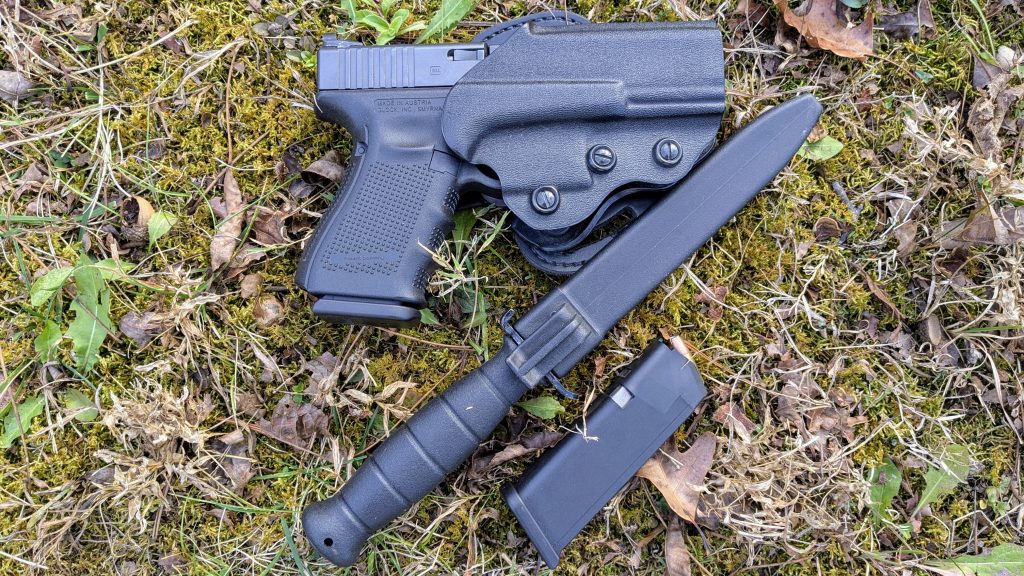
If I had to recommend one general-purpose handgun to the largest number of people, the Glock 19 would remain near the top of my list.
It is large enough to shoot well but small enough for many people to carry concealed. It uses a 15-round magazine, and magazines, holsters, parts, and accessories are widely available.
It can be used for concealed carry, open carry, home defense, travel, training, and general preparedness.
That does not mean everyone must buy one.
If you already own a dependable Smith & Wesson, SIG Sauer, Ruger, Beretta, revolver, or another quality handgun that fits you and works reliably, there may be no reason to replace it.
Familiarity and competence matter more than brand loyalty.
Learn the Correct Manual of Arms
Every owner should understand the proper operating procedures for his specific firearm.
Do not rely on a five-minute internet video and assume you now understand everything about it.
Read the owner’s manual, take qualified instruction, and establish a consistent way to load, unload, inspect, store, and operate the firearm.
Under stress, simple movements are generally easier to perform than delicate movements involving small controls. However, the technique you use should be appropriate for the specific firearm and taught by someone qualified to evaluate what you are doing.
Do not start replacing internal parts, sights, triggers, or controls unless you understand how the change affects reliability and safety.
Use a Proper Holster
A good handgun deserves a good holster.
The holster should:
- Fit the exact firearm
- Cover the trigger guard completely
- Hold the handgun securely
- Remain attached to the belt during use
- Allow safe access
- Protect the firearm from being unintentionally dislodged
When carrying openly, I prefer a holster with an active retention feature. An openly carried handgun is visible and potentially accessible to someone behind you.
Retention is less noticeable than the gun itself, but it is extremely important.
Do not collect 50 cheap holsters while searching for one that works. Buy a well-made holster designed for your firearm and intended method of carry.
3. A Dependable Shotgun
A shotgun is one of the most versatile firearms a household can own.
Depending on the configuration, ammunition, and local laws, it may be useful for:
- Hunting birds
- Hunting small game
- Hunting larger game
- Predator control
- Protecting a garden from pests
- Lawful home defense
I have always liked the Mossberg 500 and 590 series. They are widely available, generally affordable, and have a long record of service.
Remington, Winchester, Benelli, and other manufacturers also produce dependable shotguns.
A simple pump-action shotgun is usually more useful than a heavily modified shotgun covered with accessories.
Ammunition selection matters because birdshot, buckshot, and slugs are designed for different purposes. Learn what is safe, effective, and legal for the intended use and what your specific shotgun can handle.
4. A Dependable .22 Rifle
A .22 rifle may be the most useful training and small-game firearm in the collection.
The ammunition is compact and has relatively mild recoil and noise compared with centerfire rifle ammunition.
A .22 rifle can be useful for:
- Teaching basic marksmanship
- Low-cost practice
- Small-game hunting where legal
- Pest control
- General field use
My longtime favorite has been the Ruger 10/22.
The standard model is dependable and widely supported. The takedown model is especially convenient because it separates into two sections for compact storage and transportation.
Another option is the Smith & Wesson M&P 15-22. Its controls and general layout resemble an AR-15, making it useful as a lower-recoil training rifle.
Rimfire firearms can be particular about ammunition. Test several reputable loads and determine what functions reliably and shoots accurately in your particular rifle before purchasing a large quantity.
5. An Optional Hunting Rifle
A larger centerfire hunting rifle may be worth adding for people who hunt deer, elk, bear, or other large game.
Common cartridges include:
- .243 Winchester
- 7mm-08 Remington
- .270 Winchester
- .308 Winchester
- .30-06 Springfield
- .30-30 Winchester
The right choice depends on the game, terrain, expected distance, recoil tolerance, and ammunition availability in your area.
A lightweight, dependable bolt-action rifle with a quality scope can cover most hunting needs without being excessively complicated.
The Pistol-Caliber Carbine Option
A pistol-caliber carbine is worth considering, especially for someone who wants relatively mild recoil and commonality between a handgun and long gun.
The Ruger PC Carbine is one example.
Certain configurations can use widely available Glock-pattern magazines. A person could pair the carbine with a compatible 9mm handgun and simplify the types of ammunition and magazines that must be purchased and maintained.
A carbine is generally easier to shoot accurately than a handgun because it provides:
- More points of contact with the body
- A longer sight radius when using iron sights
- Better stability
- A longer barrel
- Lower perceived recoil
A pistol-caliber carbine does not replace every capability of a centerfire rifle. It is simply another option that may fit certain households better.
The same basic concept is not new. People have long paired revolvers and lever-action rifles chambered for the same cartridge.
Standardization Makes Sense
When several responsible adults in a household or preparedness group own firearms, standardization has real advantages.
Using similar platforms can simplify:
- Training
- Maintenance
- Spare parts
- Magazines
- Holsters
- Ammunition
- Optics and accessories
That does not mean every person must use a firearm that fits poorly.
It means there is little benefit in having six completely unrelated platforms when two or three compatible systems would meet everyone’s needs.
A household with several AR-pattern rifles and similar 9mm handguns will generally have an easier time managing magazines, parts, and training than a household with an unrelated collection of uncommon firearms and cartridges.
How Much Ammunition Should You Store?
People love exact numbers.
They want to be told that they need precisely this many rifle rounds, this many handgun rounds, and this many shotgun shells.
The real answer depends on:
- How frequently you practice
- How many trained shooters are in the household
- What the firearm is used for
- How expensive and available the ammunition is
- How much you can safely store
- Applicable laws and insurance requirements
I would maintain enough ammunition for regular practice, function testing, and a reasonable reserve.
Every time you use part of that reserve for training, replace it as your budget allows. Use older ammunition for practice and place newer ammunition into storage after inspecting it.
Do not buy large amounts of untested ammunition merely because it is cheap. Confirm that it functions properly and shoots acceptably in your firearms first.
Store ammunition in a cool, dry, secure location away from heat, moisture, children, and unauthorized people.
Do Not Forget Magazines and Maintenance
A firearm without dependable magazines is incomplete.
Buy quality factory magazines or well-established aftermarket magazines. Mark them so that a defective magazine can be identified and removed from service.
You should also keep:
- A proper cleaning kit
- Lubricant recommended for the firearm
- Basic inspection tools
- Spare batteries for electronic sights and lights
- Replacement parts that commonly wear or become lost
- The owner’s manual
Do not begin replacing springs, triggers, or internal components simply because someone online declared them mandatory.
Reliability should come before customization.
A Practical Home-Defense Setup
A home-defense plan should begin with strong doors, working locks, exterior lighting, smoke alarms, carbon-monoxide alarms, a charged phone, and a family emergency plan.
For many trained firearm owners, a practical bedside or quick-access setup may include:
- A securely stored defensive firearm
- A dependable flashlight
- A charged phone
- A basic trauma or bleeding-control kit
- Eyeglasses or hearing devices if required
- Quick access to house keys
If children, guests, or unauthorized people may enter the home, the firearm must be secured appropriately.
A quick-access lock box may provide a reasonable balance between accessibility and security. Choose a quality unit, bolt it to something substantial, and practice opening it under normal conditions.
Simply hiding a handgun in a dresser drawer is not secure storage.
More Equipment Is Not Always More Prepared
Body armor, gas masks, multiple long guns, night-vision equipment, and other specialized equipment may have a place for someone with the money, training, and a realistic reason to own them.
They are not where most families should begin.
For the average household, money is usually better spent first on:
- Better locks and reinforced doors
- Exterior lighting
- A monitored alarm or cameras
- Fire extinguishers
- Medical training
- A quality first-aid kit
- Secure firearm storage
- Professional firearm instruction
Buying equipment is easy. Building judgment, discipline, and skill takes time.
Training Matters More Than the Brand Name
A firearm stored in a safe and fired once a year does not make someone prepared.
You should understand how to:
- Handle the firearm safely
- Confirm its condition
- Load and unload it correctly
- Operate its controls
- Recognize and respond to a malfunction
- Clean and inspect it
- Store it securely
- Shoot it accurately
- Make lawful decisions under stress
Take training from qualified instructors. Practice what you learn. Return periodically so that poor habits can be identified and corrected.
Training should also include conflict avoidance, situational awareness, first aid, and an understanding of the laws governing possession, carry, storage, and defensive use.
Buy Fewer Firearms and Know Them Better
My advice is simple:
- Do not buy firearms at the expense of food, water, medical supplies, or emergency savings.
- Do not buy a firearm because it looks tactical.
- Do not cover a rifle with unnecessary equipment.
- Do not depend on a firearm you rarely shoot.
- Do not assume an expensive firearm makes up for poor judgment or a lack of training.
- Do not leave firearms where children or unauthorized people can reach them.
Choose a few dependable firearms that cover your realistic needs.
Standardize where it makes sense. Buy quality magazines and practical accessories. Keep the firearms maintained. Test the ammunition. Store everything securely. Get competent training and continue practicing.
A person with three dependable firearms and real skill is far better prepared than someone with 50 safe queens and no idea how to use them.
The Bottom Line
For most prepared households, a dependable centerfire rifle, handgun, shotgun, and .22 rifle will cover nearly every realistic firearm-related need.
A hunting rifle or pistol-caliber carbine can be added when it serves a clear purpose.
Anything beyond that is optional.
There is nothing wrong with collecting firearms as a hobby. Just do not confuse collecting with preparedness.
The objective is not to own the most guns, spend the most money, or look the most tactical.
The objective is to own reliable equipment, develop useful skills, protect your family lawfully, and still have enough money left to prepare for everything a firearm cannot solve.
What firearms would you include in a practical preparedness battery, and which accessories have actually proven useful to you? Add your thoughts in the comments below.
Discover more from The Survivalist Blog by M.D. Creekmore
Subscribe to get the latest posts sent to your email.
Leave a Reply