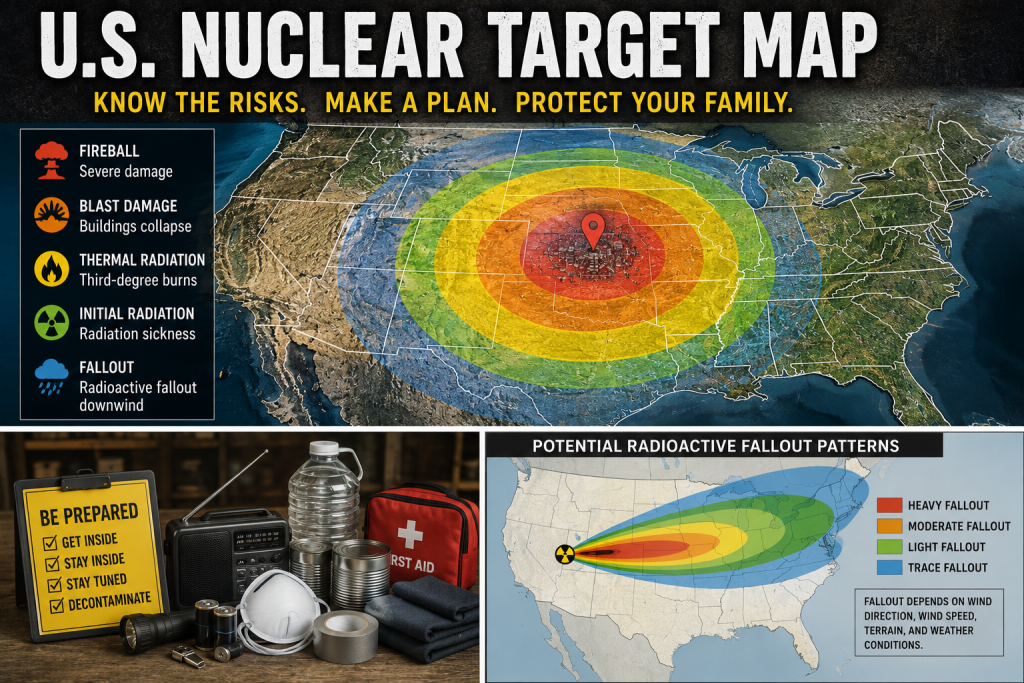
 Could you be living near a potential nuclear target?
It is not a pleasant question, but it is one worth asking. You cannot make a realistic emergency plan until you understand what hazards may be around you.
That does not mean there is a secret, perfectly accurate map showing exactly where every nuclear weapon would land. There is no reliable public list of current nuclear targets, and any map claiming otherwise should be treated as an educated estimate rather than a fact.
However, there is a useful online tool that allows you to examine what the effects of a nuclear detonation might look like in your area.
It is called NUKEMAP.
Disclosure: Some links in this article may be affiliate links. If you purchase through one of these links, I may earn a commission at no additional cost to you.
What Is NUKEMAP?
NUKEMAP is an interactive nuclear-effects simulator created by historian Alex Wellerstein.
It allows you to:
- Select a location anywhere on the map
- Choose the explosive yield of the weapon
- Compare an airburst with a surface burst
- Display estimated blast-damage zones
- Display thermal-radiation zones
- Display initial radiation effects
- Estimate casualties
- Model radioactive fallout using wind direction and speed
It is different from the old static nuclear-target maps that have circulated for decades. Instead of merely showing dots on a map, NUKEMAP lets you choose the location and type of detonation and then estimates the possible effects.
That makes it useful for understanding nuclear weapons, but it is important to understand what the program does not do.
NUKEMAP Is a Simulation, Not a Target List
NUKEMAP does not tell you which locations are currently targeted by Russia, China, North Korea, or anyone else.
You choose the target yourself.
The program then estimates what could happen based on factors such as:
- Weapon yield
- Height of detonation
- Distance from ground zero
- Wind speed
- Wind direction
- The percentage of the weapon’s energy produced by fission
- Population data
The results are estimates—not guarantees.
Buildings, mountains, valleys, weather, construction materials, warning time, population movement, and countless other factors could change the actual outcome.
Even the creator of NUKEMAP has explained that casualty calculations and fallout models continue to be updated as better data and modeling methods become available.
Use the map to understand possibilities, not to convince yourself that you are absolutely safe because your house happens to sit outside one colored circle.
How to Use the U.S. Nuclear Target Map
Using NUKEMAP is fairly simple.
- Go to NUKEMAP.
- Enter your city, town, or another location.
- Drag the marker to the exact area you want to examine.
- Select a weapon yield.
- Choose an airburst or surface burst.
- Select the effects you want displayed.
- Click the Detonate button.
You can display several different effects, including the fireball, blast pressure, thermal radiation, initial ionizing radiation, casualties, and radioactive fallout.
If you do not want the site to record anonymized information about the detonation you model, check the Don’t log usage data option.
What Size Nuclear Weapon Should You Select?
NUKEMAP gives you a long list of historical and modern nuclear weapons.
You can model anything from a small tactical nuclear weapon to an enormous Cold War-era thermonuclear bomb.
Do not make the mistake of testing only the largest bomb ever built and assuming every weapon used in a future war would be that size.
A real nuclear exchange could involve different weapons for different targets. Some could be relatively small. Others could be hundreds of kilotons or more.
Run several simulations using different yields and both airburst and surface-burst settings. That will give you a better idea of the range of possible effects.
Airburst Versus Surface Burst
The height of the explosion makes a major difference.
An airburst occurs when the weapon explodes above the ground. An airburst can spread blast and thermal effects across a wider area.
A surface burst occurs on or very near the ground. It may produce a smaller blast radius in some circumstances, but it can pull large amounts of dirt, debris, and other material into the radioactive cloud.
That contaminated material can later fall back to earth as radioactive fallout.
NUKEMAP notes that significant local fallout is primarily associated with surface bursts. That is why changing the detonation height can completely change what the map shows.
What Areas Might Be Considered Nuclear Targets?
No outsider can produce a guaranteed list of current targets. Targeting plans are classified, can change, and would depend on the goals of the country launching the weapons.
However, public discussions of possible targets often include:
- Intercontinental ballistic missile fields
- Strategic bomber bases
- Submarine bases
- Major military installations
- Command-and-control facilities
- Nuclear-weapons facilities
- Important ports and transportation centers
- Major industrial facilities
- National and regional government centers
- Large population centers
This does not mean every location on that list would be attacked. It also does not mean a rural location is automatically safe.
You may live far from the blast zone and still be downwind of radioactive fallout.
Would Oak Ridge, Tennessee, Be a Nuclear Target?
When I first used NUKEMAP, I selected Oak Ridge, Tennessee, because it was one of the closest locations to me that I believed could be considered strategically important.
Oak Ridge played a major role in the Manhattan Project and remains home to important national laboratories and nuclear-related facilities.
Does that prove Oak Ridge is on a current nuclear target list?
No.
No publicly available map can answer that question with certainty.
What NUKEMAP can do is let someone living in East Tennessee model different detonations around Oak Ridge and examine the possible blast, heat, radiation, and fallout zones.
That information can help you think through where you would shelter, which direction you might evacuate after officials advise doing so, and what supplies you would need.
Do Not Focus Only on the Blast Radius
When most people think about nuclear war, they picture a giant fireball destroying everything for hundreds of miles.
That is not how every nuclear detonation would work.
The effects can include:
- The fireball near ground zero
- Blast pressure
- Flying glass and debris
- Building collapse
- Thermal burns
- Fires
- Initial nuclear radiation
- Radioactive fallout
- Loss of electricity and communications
- Disruption of food, water, medical care, and transportation
You might be far enough away to escape the immediate blast but still close enough to suffer burns, broken windows, structural damage, or fallout exposure.
That is why looking at only one ring on the map can give you a false sense of security.
Radioactive Fallout May Be the Greater Threat for Many People
If you are not located close to ground zero, radioactive fallout may be the part of a nuclear attack that presents the greatest immediate danger.
Fallout consists of radioactive particles that descend from the cloud created by the explosion. Wind can carry those particles beyond the immediate blast area.
The exact fallout path would depend on:
- Whether the weapon was detonated at ground level or in the air
- Wind direction at different altitudes
- Wind speed
- Weather conditions
- The weapon’s yield and design
- The amount of soil and debris pulled into the cloud
A static nationwide fallout map can show broad patterns, but it cannot predict the weather or wind direction on the day of an actual attack.
This is why you should not assume you are safe simply because you live east, west, north, or south of a potential target.
What to Do If You See a Nuclear Flash
If you see a sudden, extremely bright flash, do not stand at a window trying to figure out what happened.
- Turn away from the flash.
- Close and cover your eyes.
- Drop face down.
- Cover exposed skin if possible.
- Remain down until the heat and shock waves have passed.
- Get inside the nearest substantial building as quickly as possible.
Do not drive across town attempting to reach home if a solid building is available nearby. A vehicle offers poor protection from radioactive fallout.
Get Inside, Stay Inside, and Stay Tuned
The most important official advice for a radiation emergency is simple:
Get inside, stay inside, and stay tuned.
Get into the nearest building as quickly as possible. A basement is usually best. If there is no basement, move toward the center of the building and put as much distance and solid material as possible between you and the outside.
Stay away from:
- Windows
- Exterior walls
- The roof
- Doors
- Outside air intakes
Close windows and doors. Turn off fans, air conditioners, and heating systems that pull air in from outside when possible. Close fireplace dampers.
Unless the building is on fire, collapsing, or otherwise immediately dangerous, do not rush outside based on rumors or fear.
Remain sheltered for at least 24 hours or until emergency officials provide instructions. Depending on the situation and your location, you may be told to remain inside longer or evacuate using a specific route.
Decontaminate Yourself After Going Inside
If you were outside while fallout was present, radioactive dust may be on your clothing, skin, and hair.
Removing your outer layer of clothing can remove up to 90% of radioactive contamination.
- Carefully remove your outer clothing without shaking it.
- Place it in a plastic bag or another sealable container.
- Move the bag away from people and pets.
- Shower with soap and shampoo if water is available.
- Do not use hair conditioner because it can cause radioactive material to bind to your hair.
- Do not scrub, scratch, or damage your skin.
- Put on clean clothing that was stored inside.
If you cannot shower, wash exposed skin with soap and water or wipe it with a damp cloth.
Food and Water After a Nuclear Detonation
Food and drinks that were sealed or stored inside are generally the safest choices.
Use:
- Bottled water
- Canned food
- Boxed food stored inside
- Food from closed cupboards
- Unspoiled food from the refrigerator or freezer
Wipe dust from the outside of containers before opening them.
Do not assume boiling will remove radioactive material from contaminated water. Boiling kills many microorganisms, but it does not remove radioactive particles.
Tap water may still be used for washing and decontamination even if officials temporarily advise using bottled water for drinking.
Should You Take Potassium Iodide?
Potassium iodide, usually called KI, is not a general antidote for radiation.
It protects only the thyroid gland against radioactive iodine. It does not protect the rest of your body from blast effects, gamma radiation, radioactive fallout, or other radioactive materials.
Do not take KI merely because you heard about an explosion or saw something on social media.
Take it only when public-health or emergency-management officials recommend it. KI can cause side effects and is not appropriate for everyone.
What Should You Store for a Nuclear Emergency?
You do not need a million-dollar underground bunker to improve your chances.
A practical nuclear-emergency kit should include:
- Stored drinking water
- Food that does not require refrigeration
- A battery-powered or hand-crank radio
- Flashlights and spare batteries
- A first-aid kit
- Prescription medications
- N95 or similar particulate masks
- Plastic bags for contaminated clothing
- Soap, shampoo, wet wipes, and clean towels
- Heavy work gloves
- Sturdy shoes or boots
- A non-electric can opener
- Sanitation supplies
- Pet food and pet supplies
- Printed local maps
- A dependable radiation survey meter, if you know how to use it
Keep these supplies somewhere you can reach without going outside.
A basement shelter stocked with supplies does little good if all the food, water, radio, and medical equipment are stored in an outdoor shed.
Historical U.S. Nuclear Target Maps
Several old U.S. nuclear-target and fallout maps circulate online.
Some are based on Cold War-era civil-defense planning, military facilities, missile fields, cities, and industrial areas.
They can be historically interesting and may help identify areas that were once considered important. They should not be presented as accurate maps of current targeting plans.
A map created in 1984 cannot tell us with certainty what targets would be selected today, what weapons would be used, or which direction fallout would travel.
Use historical maps as one piece of information—not as a promise that every marked location will be attacked or every unmarked location will be safe.
Recommended Nuclear-Survival Resources
- CDC: What to Do in a Radiation Emergency
- CDC: How to Decontaminate Yourself
- CDC: Food and Water Safety During a Radiation Emergency
- NUKEMAP Nuclear-Effects Simulator
- Nuclear War Survival Skills by Cresson H. Kearny
Recommended Books
- Nuclear War Survival Skills: Lifesaving Nuclear Facts and Self-Help Instructions
- No Such Thing as Doomsday
The Bottom Line
There is no public nuclear-target map that can tell you exactly what will happen during a future war.
NUKEMAP is useful because it allows you to model different weapons, locations, detonation heights, and fallout conditions. It can show you that the danger does not end at the edge of the fireball or blast circle.
Do not use it to frighten yourself, and do not use it to convince yourself that you are completely safe.
Use it to make better decisions.
Identify the strongest shelter near your home and workplace. Store food, water, medical supplies, a radio, and sanitation supplies there. Learn how to decontaminate yourself. Know that your first move after a radiation emergency will probably be to get inside—not to jump into the car and join a traffic jam.
Nuclear war is something most people would rather not think about. Ignoring the possibility, however, does nothing to protect you or your family.
Use NUKEMAP to examine your area. Are you close to a possible target, or are you more concerned about radioactive fallout? Share your thoughts below.
Discover more from The Survivalist Blog by M.D. Creekmore
Subscribe to get the latest posts sent to your email.
Leave a Reply